
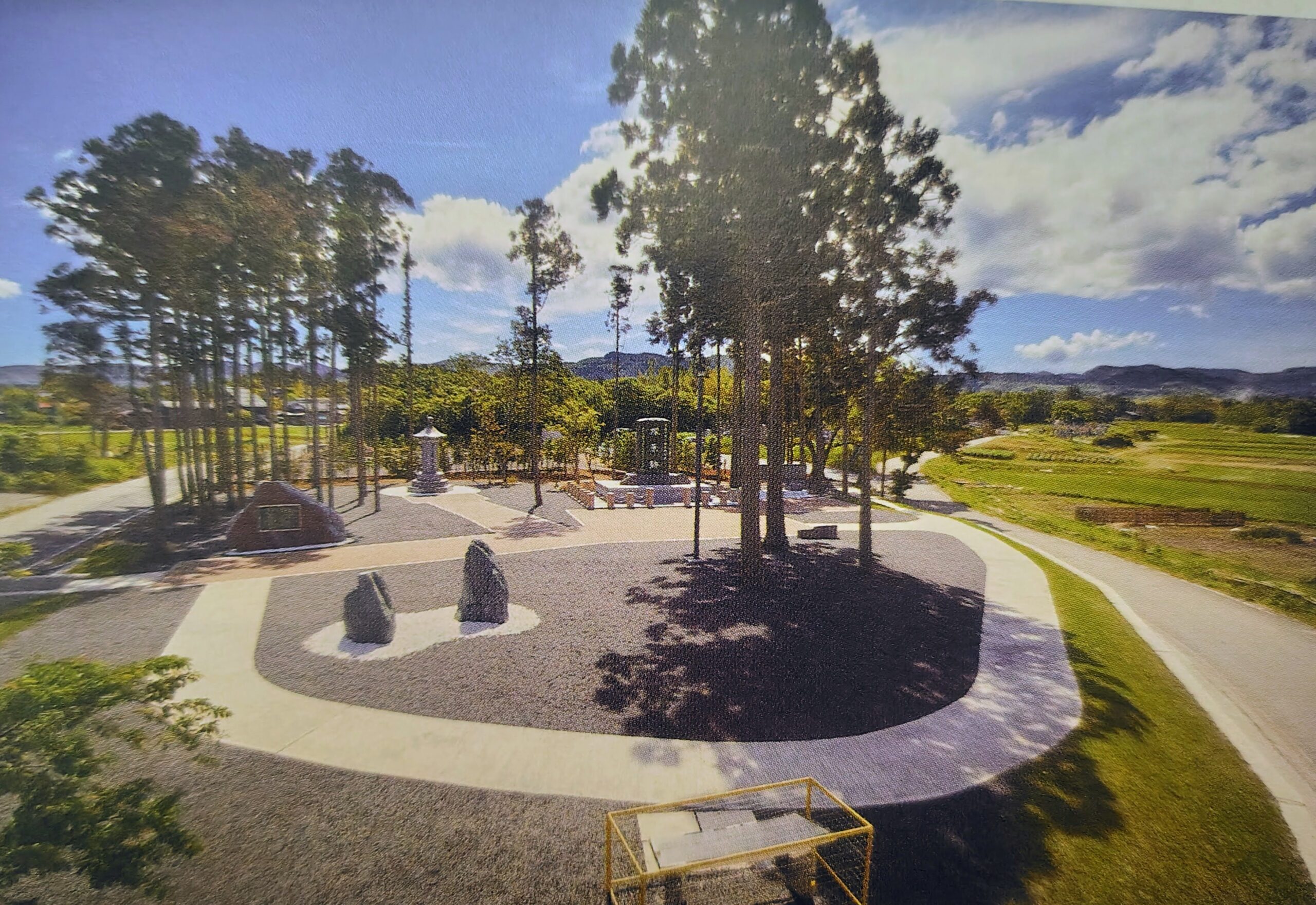
Contents
- Tatsunokuchi Persecution-Discarding the Provisional Identity and Revealing the True Identity
- On the Luminous Orb
- Sado Exile
- Tsukahara Debate
- Disturbance among Nichiren Daishonin’s Followers
- Nichiren Daishonin was concerned that many of his believers
- Relocation to Ichinosawa
- Restraining the Disciples’ Efforts to Obtain a Pardon
- The Pardon from Sado Exile
- Gosho Writings on Sado Island
Tatsunokuchi Persecution-Discarding the Provisional Identity and Revealing the True Identity
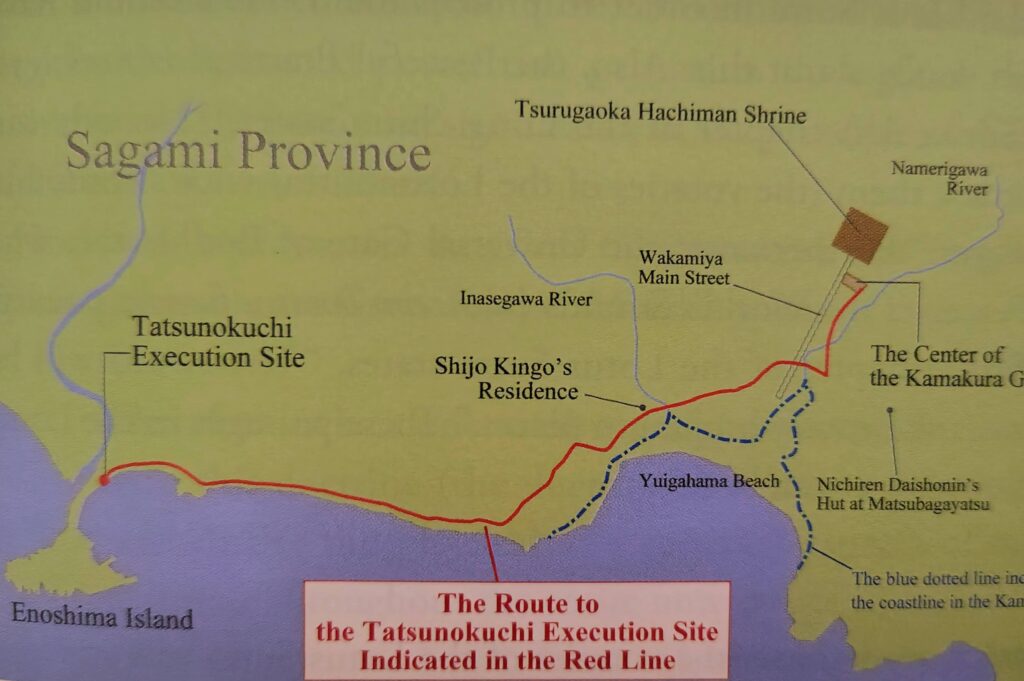
On September 12th of the eighth year of Bunnei (1271), Nichiren Daishonin was taken from his hut in Matsubagayatsu and dragged through the streets of Kamakura. He was treated like someone who had committed a serious crime. Then, the Daishonin was taken to the Supreme Court, where he was sentenced to “exile on Sado Island” by Hei-no saemon-no-jo. This “official verdict,” however, was nothing but a cover-up. In reality, the government officials true intention was to behead the Daishonin. In fact, at midnight the Daishonin was taken under guard to the Tatsunokuchi execution grounds.
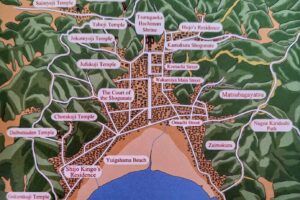
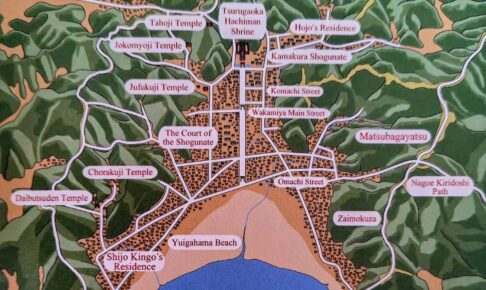
On their way to the site, the Daishonin dismounted from his horse in front of the Hachiman Shrine at Tsurugaoka (refer to the map on p. 59), and loudly called out to Bodhisattva Hachiman:
Great Bodhisattva Hachiman, are you truly a guardian deity?
(On the Buddha’s Behavior [Shuju onfurumai-gosho], Gosho, p. 1059)
He reprimanded Great Bodhisattva Hachiman for not protecting the votary of the Lotus Sutra. Then, after passing Yuigahama Beach, the Daishonin sent a boy named Kumaomaru to inform Shijo Kingo of what was happening. Shijo Kingo immediately rushed to the Daishonin’s side and accompanied him to the execution grounds with the resolution to follow his master to the grave. Upon arrival at the site, Shijo Kingo could not control himself and began to sob. The Daishonin chided him, saying:
Why can you not understand! You should be delighted at this great fortune. Have you forgotten what I told you?
(On the Buddha’s Behavior [Shuju onfurumai-gosho], Gosho, p. 1060)
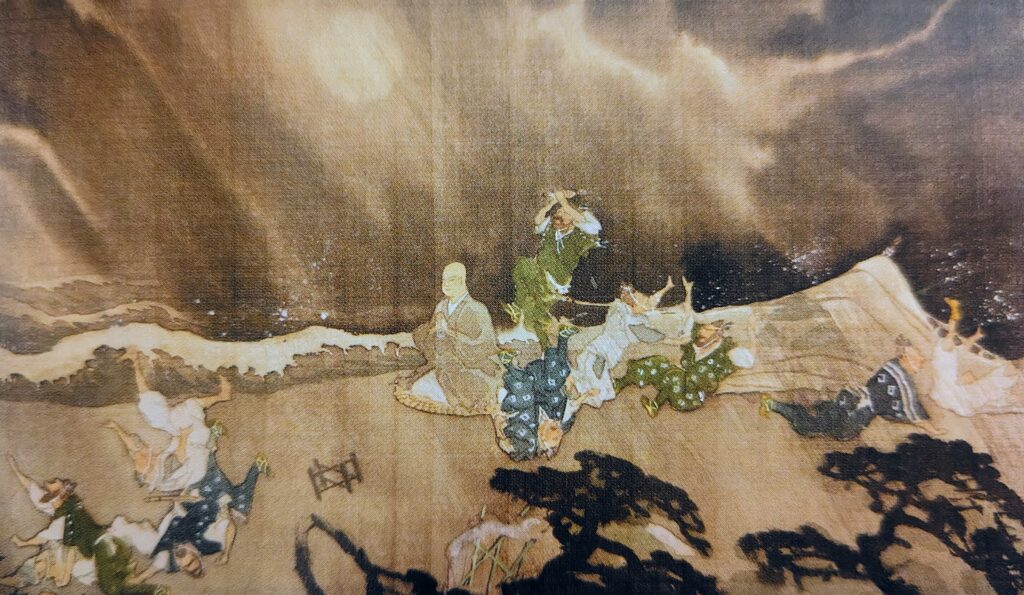
At the moment the exccutioner raised his sword,a luminous orb as a full moon At the moment the executioner raised his word, a luminous suddenly shot across the sky from bas bright e direction of Enoshima Island. The intense light blinded the ecutioner, causing him to fall down to the ground. The soldiers rrounding the Daishonin were terrified and ran about. Some threw emselves in prostration on the spot. In the end, they were not able take the Daishonin’s life.
This persecution at Tatsunokuchi has an important meaning that the Daishonin discarded his provisional identity as the incarnation of Bodhisattva Jogyo and revealed his true identity the True Buddha of the infinite past of kuon-ganjo with the roperty of intrinsically perfect wisdom. This is called “discarding the rovisional identity and revealing the true identity.”
Concerning this matter, the Daishonin states:
A man by the name of Nichiren was beheaded [as a common mortal] between the hours of the Rat and the Ox31” on the twelfth day of the ninth month of the previous year. His soul reached Sado Island…
(The Opening of the Eyes [Kaimoku-sho], Gosho, p. 563)
The word “soul” refers to the soul of the Buddha of the infinite past of kuon-ganjo with the property of perfect wisdom. In other words, in the midst of the great persecution at Tatsunokuchi, where the Daishonin had to risk his life, he revealed his life state as the True Buddha of the infinite past of kuon-ganjo.
ーーーーーーーーーー
31 The hours of the Rat and the Ox: The hours between 11 p.m. and 3 am
ーーーーーーーーーー
On the Luminous Orb
The Daishonin describes the luminous orb in Letter to Shijo Kingo (Shijo kingo dono-goshosoku):
Among the three guardian deities of light, the guardian deity of the moon appeared in the form of a luminous orb and helped me when I was about to be beheaded at the execution grounds at Tatsunokuchi. The guardian deity of the morning star descended from the heavens to greet me four or five days ago. Now only the guardian deity of the sun remains. He certainly will protect me, which is very reassuring. The Teachers of the Law (Hosshi, tenth) chapter of the Lotus Sutra states, “[The Buddha] will dispatch [Buddhas, Bodhisattvas, and guardian deities) in human form to those who propagate the Lotus Sutra in order to protect them.” You should have no doubt about this. Also, the Peaceful Practices (Anrakugy fourteenth) chapter of the Lotus Sutra states, “Nobody can attack them (the votaries of the Lotus Sutra) with swords and staves.” Furthermore, the Universal Gate of Bodhisattva who Perceives the World’s Sounds (Kanzeon bosatsu fumon, twenty-fifth) chapter of the Lotus Sutra states, “The sword will be instantaneously broken to pieces.” These passages in the Lotus Sutra never can be false.
(Goshe, p. 479)
As mentioned above, the votaries of the Lotus Sutra will undergo various persecutions, yet they will certainly receive protection from the guardian deities. In particular, the luminous orb, which appeared at Tatsunokuchi, was the materialization of protection from the guardian deity of the moon-one of the three guardian deities of light.
Scientists today, using modern analytical methods, have come up with various explanations of what this luminous ball-like object might have been. Some say that it was lightning or a shooting star. Others say it was a meteor that burned in the atmosphere and exploded into a fireball. No matter what kind of scientific theories are laid out, however, they are nothing but speculation.
The important question is why it appeared at that place, on that night, and at that very moment. In other words, it is a fact that even the government, which wielded absolute power, failed to behead the Daishonin. It is extremely significant that this phenomenon occurred right before the execution attempt and immediately after the Daishonin scolded the guardian deities. There is no explanation other than the truth of this Buddhism for such a mystic concordance of “time.” Buddhism elucidates the True Buddha’s enlightened power that permeates throughout the entire universe and the profound significance of the principle of the oneness of life and its environment.
In his Annotations on the Great Concentration and Insight (Maka shikan guketsu), the Great Teacher Miaole32” states:
Therefore, when one attains enlightenment, in accordance with this doctrine (the doctrine of ichinen sanzen), one can realize that the physical and spiritual aspects of one’s life permeate throughout the entire universe.
(Guketsu ehon, vol. 2, p. 296)
He interprets the mystic influence and the life state of the True Buddha, who realized his life is one with the entire universe, based on the principle of the oneness of life and its environment.
This phenomenon of the luminous orb clearly demonstrates that the Daishonin proved the validity of the passage cited above by undergoing the persecution himself. At the same time, he demonstrated his enlightened power as the True Buddha for all living beings.
ーーーーーーーーーー
32 The Great Teacher Miaole [711-782]: The sixth patriarch of the Tiantai sect in China,respectfully called the restorer of the Tiantai sect. He wrote Annotations on the Profound Meaning of the Lotus Suma (Hokke gengi shakusen), Annstations on the Wards and Piimases of the Lano Saitra (Hokke mongu ki), and Annetations on the Great Concentration and Insight (Maka shikan guketsu), in order to advocate the doctrines of the Great Teacher Tiantai
.ーーーーーーーーーー
Sado Exile
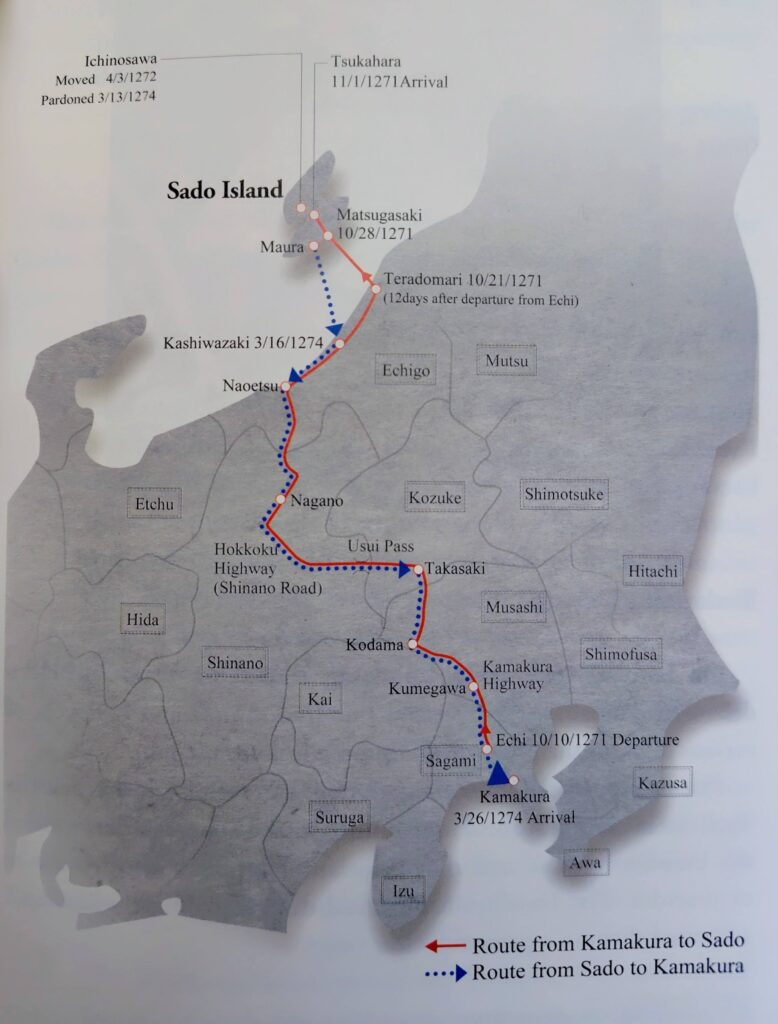
After the Tatsunokuchi Persecution, Nichiren Daishonin was held in detention at the Homma residence located at Echi, Sagami Province (presently Atsugi City, Kanagawa Prefecture) for nearly a month. On October tenth of the eighth year of Bunnei (1271), he began his journey from Echi to the place of his exile on Sado. On the 21st day of the same month, he arrived at Teradomari in Echigo (presently Niigata Prefecture). He reached Sado Island on the 28th, and started to live in a hut called Sammaido at Tsukahara (also referred to as Tsukahara Sammaido) on November first.
The Daishonin described his extremely harsh life in the severe cold at the Tsukahara Sammaido as follows:
(I was taken to a small hut) that was in the middle of a wasteland called Tsukahara in Sado. Only two meters square, it stood on some land where corpses were abandoned, a place like a graveyard on the outskirts of the capital (Kyoto). No statue of the Buddha was enshrined there and the roof and walls were full of holes. The snow fell and piled up. never melting away. I spent night and day there on a fur mat, wearing a straw cape. At night, it constantly hailed and snowed with thunder and lightning. Even in the daytime, the sun hardly shone. It was a wretched place to live.
(On the Buddha’s Behavior [Shuju onfurumai-gosho),Goshe, p. 1062)
Moreover, the islanders of Sado were Nembutsu believers, and the Daishonin’s life was always in danger.
Tsukahara Debate
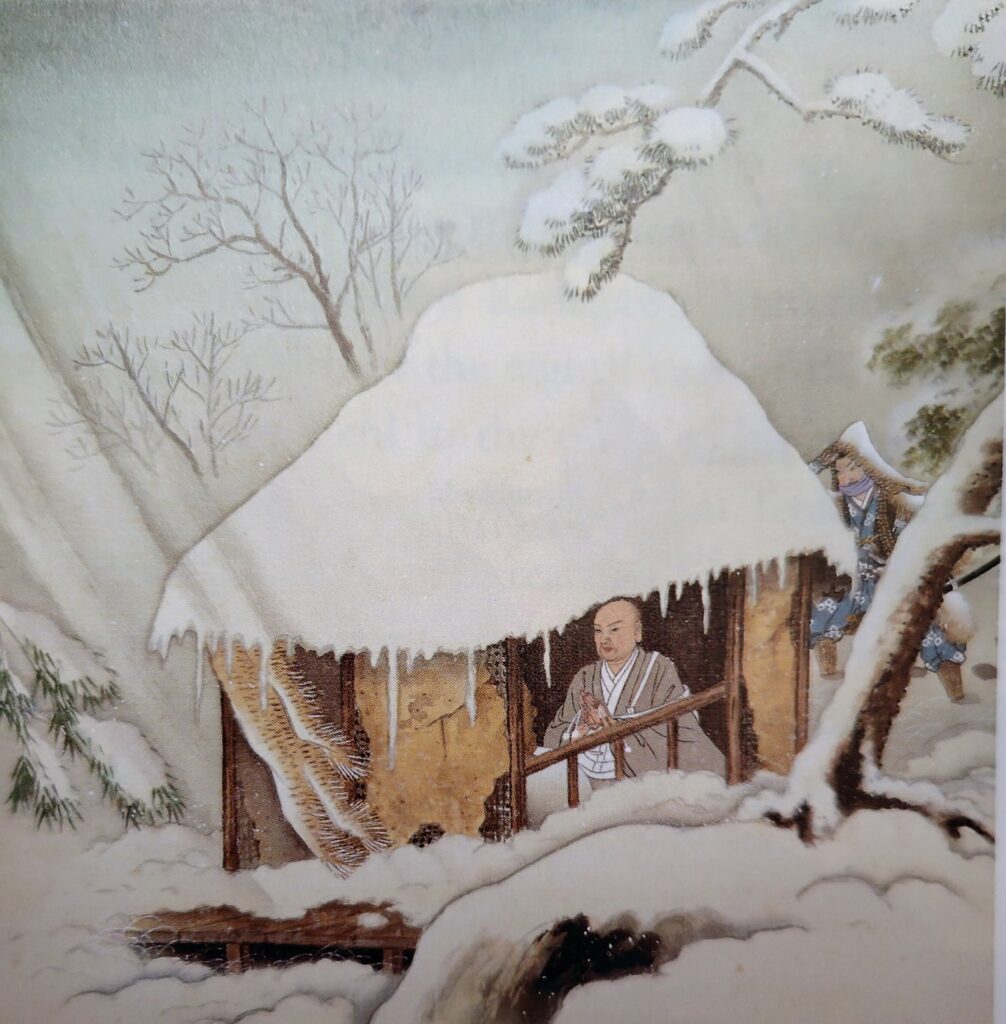
On January 16th of the following year, the Daishonin held a debate at Tsukahara with several hundred monks and believers of various sects, in the presence of Homma Rokuro zaemon33 .
Priests from various sects gathered, one after another, at the Tsukahara Sammaido. They loudly and abusively denounced the Daishonin; it is said that the clamor was like an earthquake or thunder. The Daishonin observed the crowd for a while, and addressed them in a powerful, clear voice:
.ーーーーーーーーーー
33 Homma Rokuro zaemon [Dates of birth and death unknown]: A magistrate on Sado Island. He kept Nichiren Daishonin under close surveillance during the Daishonin’s exile to Sado Island..
ーーーーーーーーーー
Be quiet, all of you. Since you have just traveled all the way [to Tsukahara] in order to defeat me based on your respective doctrines, speaking ill of and cursing me now is futile.
(On the Buddha’s Behavior [Shuju onfurumai-gosho],Gosho, p. 1064)
This was the start of the debate. He described the debate in the Gosho, On the Buddha’s Behavior (Shuju onfurumai-gosho):
The priests referred to the doctrines of the Great Concentration and Insight (Maka shikan), Shingon, and Nembutsu. For each statement they made, I carefully clarified the meaning of what they said and let them concur. Then, in return, I challenged them by strictly questioning them, and pressed them for answers. However, they could only say a few words, and then they fell silent. They were inferior to the Shingon, Zen, Nembutsu, and Tendai priests in Kamakura. You could imagine how the debate went. It was like cutting a gourd with a sharp sword, or a heavy wind bending the grass.
(Gosho, pp. 1064-1065)
Even learned priests of the major temples in Kamakura could not defeat the Daishonin in a debate. How could the priests on Sado or those from northern Japan defy him? In the same Gosho, the Daishonin goes on to describe the behavior of these priests:
[The Nembutsu believers and the Shingon, Zen, and Tendai priests] not only had a poor understanding of the Buddhist doctrines, but also contradicted themselves. They forgot the distinction between sutras and treatises, and between annotations and treatises…some became silent, others turned pale, while others declared that the teaching of Nembutsu was wrong. Some of them even spontaneously discarded their surplice and flat-shaped prayer beads (of the Nembutsu sect), and made a pledge in writing that they would never chant the Nembutsu again.
(Gosho, p. 1065)
Thus, the debate ended in an instant, due to the Daishonin’s true reasoning.
As Homma Rokuro zaemon was leaving after the debate, the Daishonin made a prediction that an uprising would occur in Kamakura in the near future.
A month later, the Daishonin’s prediction came true. An internal conflict occurred within the Hojo clan, which is known as the February Incident. Since the Daishonin’s prediction proved to be true, some of the islanders on Sado began to hold him in awe.
Disturbance among Nichiren Daishonin’s Followers
After the Tatsunokuchi Persecution, Nichiren Daishonin’s disciples and lay believers were also severely persecuted and suffered from tremendous hardships. The Daishonin states in Reply to Shijo Kingo (Shijo kingo dono-gohenji):
Several years ago, when I, Nichiren, incurred the Shogunate’s wrath, all the people throughout Japan hated me. Many of my disciples had their manors confiscated by their lords, and some believers in various places were disowned by their lords, while others were evicted from their lord’s properties.
(Gosho, p. 1117)
He also mentions in On Persecutions Befalling the Buddha (Shonin gonan ji):
Innumerable disciples of mine were killed, injured, expelled, or had fines levied against them.
(Gosho, p. 1396)
Among the Daishonin’s lay believers, some of them had their properties confiscated, some were driven out by their lords and lost their means to make a living, and others were expelled from the land controlled by their lords.
The Daishonin states in Reply to Nii ama (Nii ama gozen-gohenji):
Also in Kamakura, when the government accused me, 999 out of 1,000 believers discarded their faith
(Gosho, p. 765)
Some of the Daishonin’s followers not only discarded their faith in his teachings, but also arrogantly criticized and slandered him. He states in Letter from Sado (Sado-gosho):
When people, who appeared to believe in Nichiren, see persecutions befalling me, they harbor doubts and abandon the Lotus Sutra. These people with such distorted views would even instruct Nichiren and regard themselves wiser than me. This is truly pathetic, because they will lapse into avichi hell (hell of incessant suffering) much longer than even the Nembutsu believers…. These people say that although Nichiren is their master, he is too aggressive, and they will propagate the Lotus Sutra in a more amiable way. This is just like fireflies, with their faint glow, laughing at the bright sun and moon, a lowly anthill looking down upon the towering Mount Hua, a small inlet despising vast rivers and seas, or magpies ridiculing a phoenix.
(Gosho, p. 583)
Among those who discarded their faith, some were well known. The Daishonin mentioned this in Reply to Ueno (Ueno dono-gohenji):
My former disciples like Sho-bo, Noto-bo, and Nagoe-no ama were greedy, cowardly, and ignorant, but they called themselves wise. Because of this, when the great persecutions happened [to Nichiren], those individuals caused many people to quit their practice.
(Gosho, p. 1123)
As stated above, many of Nichiren Daishonin’s disciples and lay believers abandoned their practice as well as their master. Still, some of them maintained strong faith in the Daishonin’s true Buddhism.
Nichiren Daishonin was concerned that many of his believers
Nichiren Daishonin was concerned than many of his bilievers in Shimofusa Province might be discouraged in their faith, and therefore, on October fifth, he sent the Gosho titled The Doctrine of Lessening one’s Karmic Retribution (Tenju kyoju homon) to three of his followers, Ota, Soya, and Kimbara34.” In this Gosho, he explains the significance of overcoming the persecutions, which will come from the propagation of the true Law. A passage in this Gosho reads:
If one’s heavy negative karma accumulated since one’s past existences is not eradicated in this lifetime, then he is destined to undergo the sufferings of hell in the future. However, if he encounters severe persecutions in this lifetime, the sufferings of hell will instantly disappear, and after his death, he will receive the benefit of reaching the states of humanity, rapture, the three vehicles, or the one vehicle of Buddhahood.
(Gosho, p. 480)
In this passage, the Daishonin taught the significance of lessening one’s karmic retribution to his followers by saying that this was the time for them to do so.
.ーーーーーーーーーー
34 Kimbara [Dates of birth and death unknown]: One of the followers of Nichiren Daishonin. He received the Gosho, The Doctrine of Lessening one’s Karmic Retribution (Tenju kyoju homon), with Ota saemon-no-jo and Soya nyudo..
ーーーーーーーーーー
Immediately before his departure to Sado, the Daishonin sent a Gosho to Gijo-bo and Joken-bo of Seichoji Temple, as well as his followers in that area. This writing, titled Incurring the Displeasure of the Authorities Leading to the Sado Exile (Sado gokanki-sho) was dated October tenth. A passage in this Gosho reads:
As for the path to becoming a Buddha, it can be concluded that one can attain Buddhahood only by enduring an event that might put one’s life at risk….Only by going through such hardships could I read the Lotus Sutra with my life. With this understanding, I can summon up even more faith and look forward to my next life…. If I can lay down my life, a life that would have been lost in vain, for the sake of the Lotus Sutra, it will be likened to turning a stone into gold. Thus, each one of you need not lament over my circumstances.
(Gosho, pp. 482-483)
The Daishonin shows the path to attaining enlightenment through his behavior of enduring a great persecution that might take his life for the sake of the Lotus Sutra. He discarded his provisional identity and revealed his true identity by undergoing the persecution at Tatsunokuchi, and now is about to be banished. He describes his joy of having proven the validity of the Lotus Sutra through these actions. Even in the face of great persecutions, the Daishonin always thought about and encouraged his followers to develop unwavering faith.
Relocation to Ichinosawa
Around the summer of the ninth year of Bunnei (1272), when I was living in a place called Ichinosawa, located in Ishida Village in Sado Province…
(Letter to the Wife of Ichinosawa nyudo [Ichinosawa nyudo nyobo-gosho], Gosho, p. 829)
We can assume from the above Gosho passage that the Daishonin had been taken from Tsukahara to Ichinosawa in Ishida Village by early summer of 1272.
The reason for the relocation is not clear. One possible reason is that the government developed a feeling of awe towards the Daishonin, because his prediction of internal strife within the government came true with the occurrence of the February Incident.
About his life in Ichinosawa, the Daishonin states in the Letter to the Wife of Ichinosawa nyudo (Ichinosawa nyudo nyobo-gosho):
(Even) farmers delegated by the government office to distribute food and other items, seemed to harbor intense hatred toward me, both publicly and personally. They hated me more than even a foe of their parents or a longtime enemy.
(Gosho, p. 829)
Homma Yamashiro nyudo35,” who was appointed by Homma Shigetsura to keep an eye on the Daishonin, was a strong Nembutsu believer; therefore, he treated the Daishonin harshly.
ーーーーーーーーーー
35 Homma Yamashiro nyudo [Dates of birth and death unknown): His official name is Homma Yasunobu. During Nichiren Daishonin’s banishment to Sado Island, Yamashiro nyudo kept Nichiren Daishonin under close surveillance after the Daishonin was moved to Ichinosawa.
ーーーーーーーーーー
Although Ichinosawa nyudo, the owner of the residence, to which the Daishonin was transferred, was also a Nembutsu believer, he gradually developed a sense of respect for the Daishonin as he observed the Daishonin’s behavior.
In the Letter to the Wife of Ichinosawa nyudo (Ichinosawa nyudo nyobo-gosho) the Daishonin wrote:
The steward (Ichinosawa nyudo) of my place of exile had compassion for me deep in his heart. Although on the surface he appeared to be rigid towards me, he seemed to feel truly sorry for me.
No matter how much time goes by, I will never forget this.
(Gosho, p. 829)
Compared to the Tsukahara Sammaido, which was nothing more than an abandoned hut, the dwelling place in Ichinosawa was considerably better. However, by this time, there were more disciples who accompanied the Daishonin, and they were suffering from lack of food.
He described his life in the Letter to the Wife of Ichinosawa Nyudo (Ichinosawa Nyudo Nyobo-gosho):
The food given by the farmers was not sufficient. Because many disciples accompanied me, we barely had a few mouthfuls of rice, placed on wooden trays [without proper dishes] or directly into our hands.
(Gosho, p. 829)
Restraining the Disciples’ Efforts to Obtain a Pardon
At that time in Kamakaura, some of the Daishonin’s disciples were petitioning the authorities to issue Nichiren Daishonin a pardon. However, the Daishonin strictly instructed them through Toki Jonin to restrain their activities. This is because the Daishonin did not need to yield to the government by asking for a pardon, as if he were to blame. Rather, his true intention was to open the blind eyes of influential government officials who were ruling Japan and save all the people in the country. Therefore, in May of the ninth year of Bunnei (1272), the Daishonin severely warned his disciples in The Distinction between the Lotus Sutra and Erroneous Teachings such as the Shingon Sect (Shingon shoshu imoku):
If any of my disciples behaves in a manner that might indicate Nichiren is begging the authorities to pardon him from exile, such a disciple is unfaithful (to Nichiren). Under no circumstances would I ever save such a person in his next life, either. Each one of you must understand this matter.
(Gosho, p. 602)
Toki Jonin was grieving over the fact that Nichiren Daishonin had not been pardoned. So the Daishonin sent him the Gosho, Reply to Toki (Toki dono-gohenji) in July of the tenth year of Bunnei (1273). He encouraged Toki and all the other followers by expressing his conviction that the true Law would prevail. He stated:
You should not lament over the fact that I have not been pardoned from exile. I am fully aware of the cause of misfortunes in Japan. Some of the predictions in my letter of remonstration have already occurred, and others are yet to occur. Regardless of whether Nichiren survives or not, the five characters of Myoho-Renge-Kyo will prevail without doubt.
(Gosho, p. 679)
Nichiren Daishonin’s life in Ichinosawa was not easy. However, through daily interactions with the Daishonin, Ichinosawa nyudo and his family members gradually understood the significance of faith in the true teaching and in the end, they came to protect the Daishonin. Moreover, the Daishonin’s disciples and lay believers who resided far and near started to send him various offerings.
The Pardon from Sado Exile
In the 11th year of Bunnei (1274), an emissary from the Mongolian empire again came to Japan. Thus, Nichiren Daishonin’s prediction of the disaster of invasion from foreign lands seemed to be coming true. Moreover, natural disasters occurring one after another caused even further confusion throughout the nation. The people of Japan were spending their days in constant anxiety. Seeing these chaotic phenomena and concluding that Nichiren Daishonin was exiled for no reason, Hojo Tokimune, the regent of the Kamakura government at the time, issued a pardon for the Daishonin on February 14th of the same year.
The letter of pardon was delivered to the Daishonin on March eighth, and he and his followers left Ichinosawa on Sado Island on the 13th day of the same month. On the way to Kamakura, Nembutsu believers in Echigo (current Niigata Prefecture) and Shinano (current Nagano Prefecture) Provinces gathered at Zenkoji Temple, planning to ambush and kill the Daishonin. However, they were not able to carry out an attack, since the Daishonin was escorted by soldiers. Nichiren Daishonin arrived safely in Kamakura on the 26th day of the same month.
During the Daishonin’s two-and-a-half-year exile on Sado Island, Nikko Shonin devotedly served him. During that time, Abutsu-bo36 and his wife Sennichi ama37. Ko nyudo and his wife Ko ama38, Sairen-bo39,” Nakaoki nyudo40,” and other people living on Sado became the Daishonin’s followers.
ーーーーーーーーーー
36 Abutsu-bo [1189-1279): His full name is Abutsu-bo Nittoku. He became a follower of Nichiren Daishonin while the Daishonin was living in exile on Sado Island. He was one of the main Hokkeko believers of Sado. His wife was Sennichi ama. Despite his advanced age of 90, he made a pilgrimage multiple times to visit the Daishonin in Mount Minobu,
37 Sennichi ama [2-1302]: She became Nichiren Daishonin’s believer with her husband, Abutsu-bo, and devotedly protected the Daishonin, when he was exiled to Sado Island. She supported Abutsu-bo so that he could make pilgrimages to Mount Minobu, where the Daishonin resided.
38 Ko nyudo and Ko ama [Dates of birth and death unknown]: A couple who were Nichiren Dasihonin’s followers on Sado Island. They were on friendly terms with Abutsu-bo and his wife. During the banishment of Nichiren Daishonin to Sado Island, they devotedly protected the Daishonin. Ko ama supported Ko nyudo when he visited the Daishonin twice at Mount Minobu. They were given the Goshos, including Reply to Ko nyude (Ko nyudo dono-gohenji).
39 Sairen-bo [7-1308]: A priest who originally studied the Tendai doctrine. He became Nichiren Daishonin’s disciple during his exile to Sado Island.
40 Nakaoki nyudo [Dates of birth and death unknown]: One of Nichiren Daishonin’s followers on Sado Island. He lived in Nakaoki on Sado Island. It is said that he, his father, and his entire family practiced Nichiren Daishonin’s Buddhism. He was given the Gosho Letter to Nakaoki nyude (Nakaoki nyudo-goshosoku) by the Daishonin
ーーーーーーーーーー
Gosho Writings on Sado Island
During his exile on Sado, the Daishonin authored more than 50 writings, including On the Heritage of the Ultimate Law of Life and Death (Shoji ichidaiji kechimyaku-sho), The True Entity of All Phenomena (Shoho jisso-sho), and On the Meaning of the True Entity of Myoho-Renge-Kyo (Totaigi-sho). The most significant Goshos among these writings are The Opening of the Eyes (Kaimoku-sho) and The True Object of Worship (Kanjin no honzon-sho). In February of the ninth year of Bunnei (1272), the Daishonin wrote The Opening of the Eyes in the severe cold at the Tsukahara Sammaido, where paper and sumi ink were scarce.
There were basically two major reasons why this Gosho was written. One was to open up the blind eyes of all living beings, who are ignorant of the teachings of true Buddhism, and to lead all the people in the Latter Day of the Law to the Daishonin’s true teaching. The other reason was to encourage the Daishonin’s disciples and lay believers, who were deeply discouraged due to the Daishonin’s exile. Many of them were on the verge of abandoning their faith, while others already had forsaken their faith.
In this Gosho, the Daishonin reveals that he, himself, is the votary of the Lotus Sutra, as he had undergone persecutions that had put his life at risk. He also clearly states that he is the Buddha to be revered by all people in the Latter Day of the Law who possesses the three virtues of sovereign, teacher, and parent. For these reasons, this Gosho is said to be the treatise that revealed the object of worship in terms of the person.
The Daishonin wrote The True Object of Worship at Ichinosawa on Sado Island on April 25th in the following year. The Daishonin states:
(What is described in The True Object of Worship is the most significant to Nichiren.
(Cover Letter to the True Object of Worship
[Kanjin no honzon-sho soejo], Gosho, p. 662)
This Gosho reveals that the Daishonin makes his advent as the True Buddha at the beginning of the Latter Day of the Law and establishes the Gohonzon of the sowing hidden in the depths of the Life Span chapter of the Lotus Sutra for all living beings. For this reason, this Gosho is said to be the treatise that reveals the object of worship in terms of the Law.
The Daishonin states:
You should realize that the doctrines [expounded by Nichiren prior to my exile to Sado Province correspond to Shakyamuni’s pre-Lotus Sutra teachings.
(Letter to Misawa [Misawa-sho], Gosho, p. 1204)
This means that there is a profound difference between the Daishonin’s doctrines and behavior before and after he discarded his provisional identity and revealed his true identity. In other words prior to the Sado Exile, the Daishonin propagated his teachings a the reincarnation of Bodhisattva Jogyo (Superior Practice). Therefore he did not inscribe the Gohonzon before Sado. However, after h discarded his provisional identity and revealed his true identity, h began to inscribe the Gohonzon and lead all living beings as the Tru Buddha of the Latter Day of the Law.