Contents
Document for Entrusting the Law that Nichiren Propagated throughout bis Life (Nichiren ichigo guho fuzokusho)
In September of the fifth year of Koan (1282), the Daishonin chose Nikko Shonin among his disciples and bequeathed to him the Dai-Gohonzon of the High Sanctuary of the Essential Teaching. This means that the Daishonin put Nikko Shonin in charge of all of the Daishonin’s disciples and lay believers after his passing and delegated to him the responsibility of leading the entire denomination in propagating the true Law.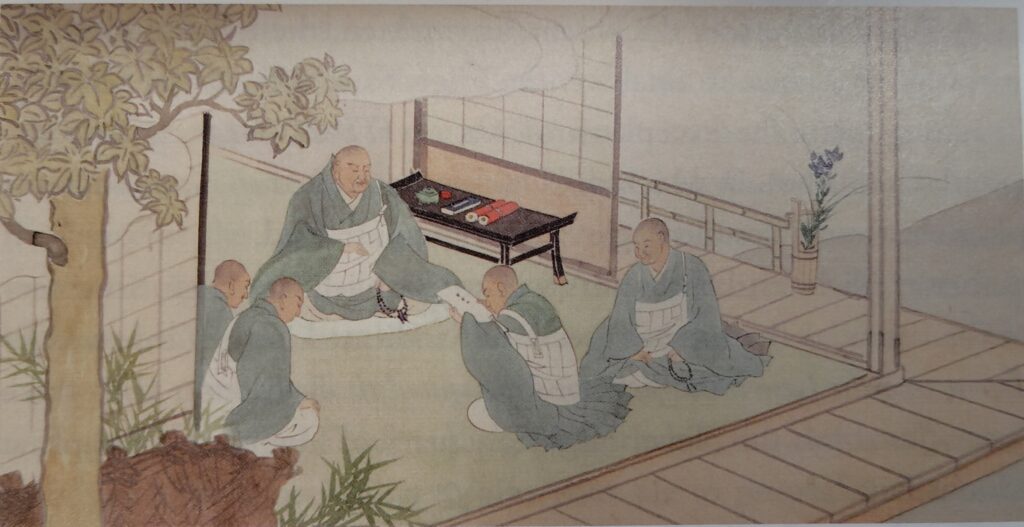
As proof, the Daishonin transmitted the entirety of his teachings to Nikko Shonin through the following transfer document:
I, Nichiren, transfer the entirety of the Law that I have propagated throughout my life to Byakuren Ajari Nikko and designate him the Great Master of Propagation of the Essential Teaching. When the sovereign embraces this Law, establish the [True] High Sanctuary of Hommonji Temple at Mount Fuji. You must await the time. This is the actual precept of the Law.
Above all else, my disciples must obey this document.
The ninth month in the fifth year of Koan (1282)
Nichiren (signature mark)
The order of the Heritage of the Law: from Nichiren to Nikko
(Document for Entrusting the Law that Nichiren Propagated throughout his Life [Nichiren ichigo guho fuzokusho],
Gosho, p. 1675)
Before this transfer document was written, there was no specific mention of a place to establish the High Sanctuary of the Essential Teaching with the exception of On the Three Great Secret Laws (Sandai hiho-sho), in which the Daishonin referred to it as a supreme place that resembles the Eagle Peak of the pure land.
It was Nichiren Daishonin’s will to establish the High Sanctuary of the Essential Teaching as specifically indicated in the Document for Entrusting the Law that Nichiren Propagated throughout his Life, which states, “establish the [True] High Sanctuary of Hommonji Temple at Mount Fuji.”
The reason why the Daishonin transmitted the Lifeblood Heritage of the Law to Nikko Shonin is because among his many disciples, Nikko Shonin upheld absolute faith in the Daishonin and faithfully and constantly served the Daishonin based on the true master and disciple relationship. Furthermore, Nikko Shonin was outstanding among all the disciples in every aspect including his depth of understanding the Daishonin’s Buddhism and his noble character. In order to propagate the doctrine down through the ages, exactly as taught by the Daishonin, based on the traditional standard of Buddhism, the Daishonin selected only Nikko Shonin from among all his disciples and transferred his entire teachings solely to him.
Bushu Ikegami
The Daishonin, who had been ill in his later years, was urged by his disciples to go to Hitachi (present-day Iwaki City, Fukushima Prefecture) for recuperation in the hot springs. On September eighth in the fifth year of Koan (1282), the Daishonin left Minobu, escorted by Nikko Shonin and other disciples. On the 18th of the same month, en route, they arrived at the residence of the lord of Bushu Ikegami (present-day Ota Ward, Tokyo), Emon-no-taifu Munenaka68
Starting on the 25th of the same month, at the Ikegami residence, the Daishonin gave lectures on the Rissho ankoku-ron (On Securing the Peace of the Land Through the Propagation of True Buddhism) to his disciples and lay believers. In these lectures, the Daishonin expressed his intention that all the disciples and lay believers should exert their utmost efforts toward the accomplishment of kosen-rufu with the spirit of “one’s life is insignificant while the Law is supreme,” and “you should be willing to give your life to propagate the Law.” This is because the Daishonin’s spirit of shakubuku is revealed in the Rissho ankoku-ron.
ーーーーーーーーーー
68 Emon-no-taifu Munenaka [Dates of birth and death unknown]: Ikegami emon-no-taifu Munenaka, whose younger brother was Ikegami Munenaga. They became believers of Nichiren Daishonin in 1256. Munenaka was disowned twice by his father, who was a strong supporter of Ryokan of Gokurakuji Temple. However, together with Munenaga, Munenaka finally led his father to take faith in the Daishonin’s teaching, Nichiren Daishonin passed away at Ikegami Munenaka’s residence in Ikegami (present-day Ikegami of Ora Ward in Tokyo),
ーーーーーーーーーー
Minobu-san Transfer Document (Minobusan fuzokusho)
On October eighth of the fifth year of Koan (1282), Nichiren Daishonin selected his six major disciples69 : ” Nissho, Nichiro, Nikko, Niko, Nitcho, and Nichiji. After that, he bestowed upon his successor, Nikko Shonin, the two documents, On the Transmission of the Seven Significant Teachings Regarding the Object of Worship (Gohonzon shichika no sojo) and The Transmission of the Heritage of the Law in the Hokke Hommon Sect (Hokke hommon shu kechimyaku sojo ji, also known as On the True Cause [Honnin myo-sho]).
Furthermore, the Daishonin, feeling the time of his demise was approaching, appointed Nikko Shonin as the chief priest of Minobu-san Kuonji Temple70. The Daishonin stated:
I transfer Shakyamuni Buddha’s teachings of fifty years to Byakuren Ajari Nikko. He is to be the chief priest of Minobu-san Kuonji Temple.” Laity or priests who disobey him will go against the Law.
The thirteenth day of the tenth month in the fifth year of Koan (1282)
Nichiren (signature mark)
Ikegami, Bushu Province
(Minobu-san Transfer Document [Minobusan fuzokusho],
Gosho, p. 1675)
ーーーーーーーーーー
69 Six major disciples : Six priests who were appointed by Nichiren Daishonin, later referred to as the six senior priests. From among them, only Nikko Shonin received the entirety of the Law. The other five priests disobeyed the Daishonin’s will and refused to follow Nikko Shonin, the Daishonin’s successor.
70 Minobu-san Kuonji Temple : A temple located in what is presently known as the Minobu Town in Minamikoma County, Yamanashi Prefecture. Nichiren Daishonin lived there for more than 8 years from 1274 to 1282.
ーーーーーーーーーー
In the Minobu-san Transfer Document (Minobusan fuzokusho), Nichiren Daishonin declared that he had transmitted the Heritage of the Law, entrusted to a single person, to Nikko Shonin, and further, he strictly admonished that any priest or lay believer who did not follow Nikko Shonin would be going against and slandering the Law.
As stated in the Document for Entrusting the Law that Nichiren Propagated throughout his Life (Nichiren ichigo guho fuzokusho), Nikko Shonin received the transmission of the entirety of Nichiren Daishonin’s Buddhism, including the Dai-Gohonzon of the High Sanctuary of the Essential Teaching, the origin of the Three Great Secret Laws. Moreover, in the Minobu-san Transfer Document, the Daishonin declared that Nikko Shonin was appointed as the leader of all the priests and lay believers. These two transfer documents were prepared by Nichiren Daishonin in order to clarify the position of Nikko Shonin as the Great Master of Propagation of the Essential Teaching, who had received the transmission of the Lifeblood Heritage of the Law, entrusted to a single person.
The Passing of Nichiren Daishonin and his Funeral Ceremony
At the hour of the Dragon (approximately 8 a.m.) on October 13th of the fifth year of Koan (1282), at the age of 61, Nichiren Daishonin, who had completed the transmission of his teachings and guidance, peacefully passed away, as his disciples and believers chanted Daimoku. It is said that at the time of the Daishonin’s death, the earth trembled and the cherry trees in the garden all blossomed together, even though it was the beginning of winter.
There is a profound significance regarding the demise of the True Buddha, Nichiren Daishonin. It is the unfathomable Buddhist teaching that Nichiren Daishonin’s life as the True Buddha eternally exists, while his physical body, which emerged as a common mortal in the Latter Day of the Law, is extinct.
On October 14th, the day after Nichiren Daishonin’s passing, his body was placed in a coffin at the hour of the Dog (approximately 8 p.m.). Then, it was carried to the cremation ground by the funeral procession at the hour of the Rat (approximately 12 a.m.) and cremated there. The Daishonin’s ashes were then placed in an urn. The entire funeral ceremony of Nichiren Daishonin was solemnly conducted.
Following the Daishonin’s will, all aspects of Nichiren Daishonin’s funeral were officiated by Nikko Shonin, the Great Master, who received the transmission of the Heritage of the Law, entrusted to a single person. Nikko Shonin, himself, recorded the proceedings of the Daishonin’s funeral ceremony as The Record of the Passing of our Founder (Shuso gosenge kiroku).
Subsequent to the funeral of Nichiren Daishonin, Nikko Shonin officiated the memorial ceremony for the seventh-day after the Daishonin’s passing. Then Nikko Shonin, carrying the urn containing Nichiren Daishonin’s ashes, left Ikegami in the early morning on October 21st, and returned to Mount Minobu on the 25th of the same month.
The Great Master of Propagation of the Essential Teaching
As the Great Master of Propagation of the Essential Teaching, Nikko Shonin protected the Dai-Gohonzon of the High Sanctuary of the Essential Teaching while taking a leadership role in all other temple-related matters, including the selection of the place where the Daishonin’s urn should be enshrined.
After several years, however, Hakiri Sanenaga, the lord of Mount Minobu, began to commit various slanders, even though he had converted to the Daishonin’s Buddhism and had begun his practice as a disciple of Nikko Shonin. He was deluded by one of the six senior priests, Mimbu Niko. In spite of Nikko Shonin’s repeated warnings. Sanenaga never listened to him. Ultimately, he turned against Nikko Shonin.
At this point, Nikko Shonin came to the conclusion that the Daishonin’s teaching would be tainted with slander if he continued to remain in Minobu.
In other words, he had no other choice but to leave Minobu in order to perpetuate the Daishonin’s true teaching. Nikko Shonin quoted the Daishonin’s will in Reply to Mimasaka-bo as follows:
When the lord of Mount Minobu goes against the Law, I (Nichiren) will no longer reside in such a place
(Reply to Mimasaka-bo [Mimasaka bo-gohenji], Seiten, p. 555)
The Daishonin also made reference to the establishment of the High Sanctuary of Hommonji Temple at Mount Fuji. Therefore, Nikko Shonin finally made the decision to depart Minobu, based on the Daishonin’s will.
Nikko Shonin expressed his thoughts as follows:
Words cannot express the shame and self-reproach that I feel over leaving the mountain valley of Minobu. Having inherited the true Law directly from Nichiren Daishonin, I thought about this matter repeatedly. I came to be convinced that wherever I reside, what is most vital for me is to have the people throughout the world uphold it. Despite my efforts to persuade them, most of the Daishonin’s disciples have turned their back on their master. I understand that only I, Nikko, am the person who upholds our master’s correct teaching, and that I am the only one who will accomplish his ultimate purpose. I never forget his true intention.
(Reply to Hara [Hara dono-gohenji], Seiten, p. 560)
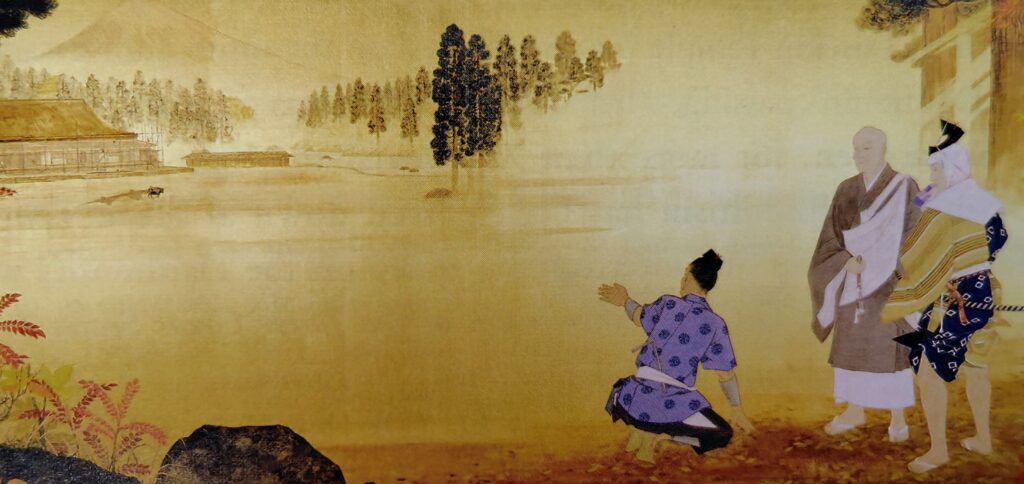
For the sake of the perpetuation of the Law and kosen-rufu, with strong reluctance, Nikko Shonin left Mount Minobu with Nichimoku Shonin and other disciples in the spring of the second year of Sho-o (1289), taking the Dai-Gohonzon of the High Sanctuary of the Essential Teaching, the Daishonin’s ashes, his Gosho writings, and all his other mementos.
Nanjo Tokimitsu71,” the lord of Ueno Village in Fuji County, offered Nikko Shonin a field called Oishi-ga-hara, located at the foot of Mt. Fuji. Nikko Shonin built Taisekiji Temple on this land. The basis of Taisekiji Temple was established on October 12th, in the third year of Sho-o (1290). This laid the foundation for the worldwide propagation of Nichiren Daishonin’s Buddhism.
ーーーーーーーーーー
71 Nanjo Tokimitsu [1259-1332]: One of the influential believers during Nichiren Daishonin’s lifetime. He was the lord of Ueno Village. His father was Nanjo Hyoe Shichiro, his mother was also known as Ueno ama, a daughter of Matsuno Rokuro saemon, and his elder sister was the mother of Nichimoku Shonin. He constantly made offerings to the Daishonin, and during the Atsuwara Persecution, played an important role under Nikko Shonin’s direction. Because of his firm faith, he was referred to as “Ueno the Wise” and received many Gosho writings from the Daishonin, including Many in Body. One in Mind (Itai doshin ji) and Reply to Ueno (Ueno dono-gohenji). Later on, when Nikko Shonin left Mount Minobu, he invited Nikko Shonin to Ueno Village. He offered the land for Taisekiji and helped Nikko Shonin establish the Head Temple.
ーーーーーーーーーー
Thus, Taisekiji Temple was established on the ninth anniversary of the Daishonin’s passing, when Nikko Shonin was 45 years old.
Since then, for more than 700 years, the light of Nichiren Daishonin’s Buddhism has been passed down at Head Temple Taisekiji without any interruption, based on the Daishonin’s will, as indicated in On the Transmission of the Three Great Secret Laws (Sandai hiho bonjo ji), and Document for Entrusting the Law that Nichiren Propagated throughout his Life (Nichiren ichigo guho fuzokusho).
Today, all Nichiren Shoshu priests and lay believers are advancing in unity toward the accomplishment of worldwide kosen-rufu and the salvation of all mankind for eternity.
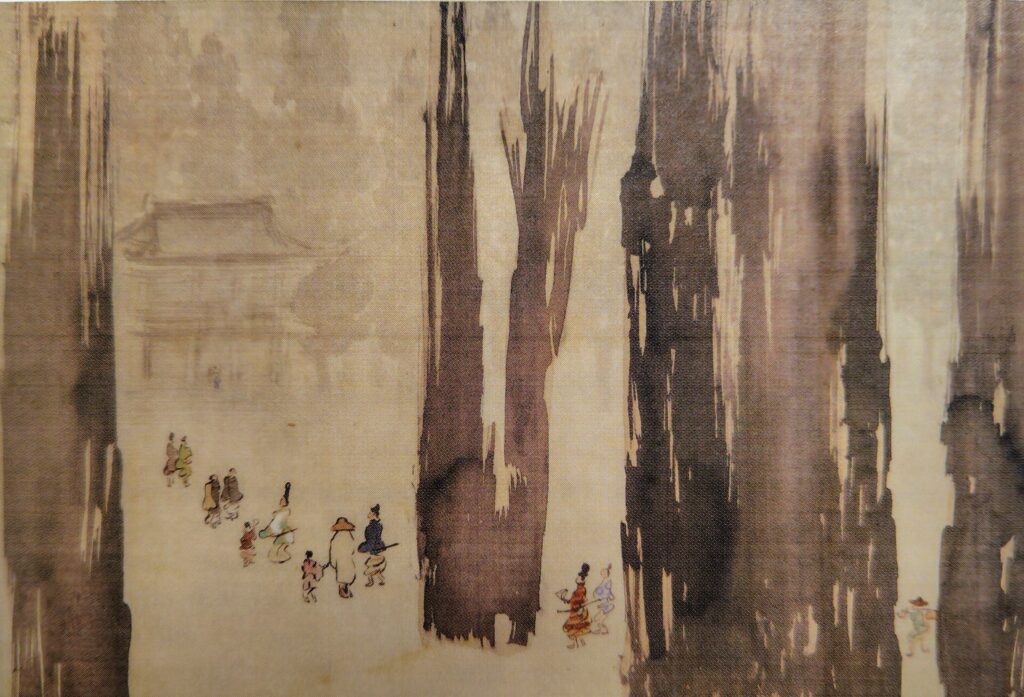 Sammon Gate of Head Temple Taisekiji drawn circa 1910
Appendix I
Names of the Samurai
Samurai warriors in general bore a title following their sir name, as in the example of Ota saemon-no-jo (“Ota” is the sir name, while “saemon-no-jo” is the title). The title originally indicated one’s military post assigned by the imperial court, and the samurais fulfilled their responsibility according to their title. However, it merely became a formality since many people during the Kamakura period chose their title as they preferred.
On the other hand, high-ranking officials of the Kamakura government, who were given a title by the imperial court, fulfilled their specific duties.
These officials and other samurais succeeded to and used their father’s title in many cases.
The following are examples:
・Saem
・on-no-jo (Saemon is also pronounced Zaemon)
・Emon-no-taifu
・Hyoe-sakan
・Kingo