His Birth
Nichiren Daishonin was born in a fishing village called Kataumi, located in Tojo Village in Nagasa County of Awa Province (currently Kamogawa City, Chiba Prefecture) on February 16th of the first year of Jo-o (1222). His father was Mikuni-no-taifu (Nukina Jiro) Shigetada, and his mother was Umegikunyo. He was named Zennichimaro at birth.
The Daishonin states the following about his origin:
I, Nichiren, in this life was born poor and lowly to a Chandala family.
(Letter to Sado [Sado-gosho], Gosho, p. 580)
ーーーーーーーーーー
1 Chandala: The lowest social class in ancient India that made a living from killing animals or handling corpses.
ーーーーーーーーーー
1. Nichiren, am the child of a Chandala family from Isonaka, Kataumi, located in Tojo Village of Awa Province.
(The Tripitaka Master Shan Wu Wei [Zemmui sanzo-sho).
Gosho, p. 438)
He explains that he was born the lowest social class. These passages indicate a Buddha was born in India to a He explains that he was born into the lowest social class. These profound meaning in Buddhism. Shakyamuni royal family, and his Buddhism would bring salvation only to the people living during his lifetime, Buddha, Nichiren Daishonin, as the True Buddha, was born to the and in the Former and Middle Days of the Law. Unlike Shakyamuni lowest social class, and his Buddhism will save all living beings in the Latter Day of the Law.
Omens
Before Nichiren Daishonin was born, various mystic omens were seen. In later years, the Second High Priest Nikko Shonin transcribed the Daishonin’s words about his birth in On What Nikko Shonin Heard from Nichiren Daishonin about his Birth (Ubuyu sojo no koto). This is an indispensable and important record of transmission regarding the significance of the Daishonin’s birth. This record reveals that the Daishonin’s mother had a mystic dream, stating that when his mother conceived the Daishonin, she said:
ーーーーーーーーーー
2 India India in those days used to be a vast area of Southern Asia, including current India, Nepal, Bangladesh, and Pakistan.
3 Omens: Phenomena which occur beforehand to indicate that something very important going to happen. For example, magnificent omens occurred before the birth and death of Buddhas.
ーーーーーーーーーー
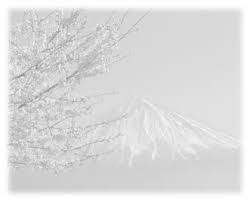
One night, I (Nichiren Daishonin’s mother) had a mystic dream. In it, I sat on Mount Hiei and washed my hands with water in the lake in Omi Province. At that time, the sun rose up from Mount Fuji and entered into my body.
(On What Nikko Shonin Heard from Nichiren Daishonin about his Birth [Ubuyu sojo no koto], Gosho, p. 1708)
This mystic dream was, indeed, a good omen, which suggested the advent of the Buddha in the Latter Day of the Law.
The Daishonin in later years writes about a mystic dream that Queen Maya had when she conceived Shakyamuni Buddha:
Queen Maya had a dream that she conceived the sun, and soon after gave birth to Prince Siddhartha. Thus, the childhood name of [Shakyamuni] Buddha is translated as Ni-sshu (the Sun and Seed).
(The Selection of the Time [Senji-sho], Gosho, p. 862)
From this description, we can see that the mystic dreams related to both the Daishonin and Shakyamuni Buddha were very similar.
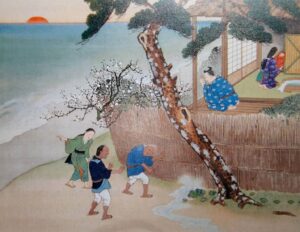
According to a legend, a few days prior to the Daishonin’s birth, blue lotus flowers suddenly appeared on the surface of the ocean and bloomed beautifully. Even today, the surrounding beach stil retains the name, “Renge-ga-fuchi” (Lotus Flower above the Deep Water).
Moreover, on the day the Daishonin was born, it is said lotus flowers bloomed in a garden pond. Also on this day, it is that gigantic sea breams leaped out of the sea, as if to celebran Daishonin’s birth. Even now, this area is called the “Tai-no-ura”(Seashore of Sea Breams) where large sea breams live in the water. Still today, it is a mystery as to why sea breams, a deep-sea fish, stay In the shallow waters near the shore in this area.
Even more mystic is the fact that Shakyamuni Buddha from India entered nirvana on February 15th, whereas the Daishonin from apan was born on February 16th. This symbolizes a mystic karmic clation, indicating that the Buddhism of maturing and harvesting f Shakyamuni Buddha will vanish in the Latter Day of the Law, hile the Buddhism of sowing will emerge and be propagated by the Daishonin.
We can take these numerous, mystic, causal relations and actual henomena as a sign of the entire universe seeking and admiring the dvent of the True Buddha.
The Daishonin made his advent as the True Buddha in the Latter ay of the Law. When he was born, the Buddha nature of the ountains, rivers, grasses, and trees throughout the ten directions of e entire universe manifested auspicious omens of joy toward the Cation of Kataumi in Awa Province.
His Birthplace
Nichiren Daishonin was born in Kataumi as described in estions and Answers on the Object of Worship (Honzon mondo-), which states:
I, Nichiren, am the child of a fisherman, who lived in Kataumi, located in Tojo Village in Nagasa County of Awa Province, which corresponds to the 12th [location] of the 15 provinces in the Tokaido region [in terms of distance from the capital].
(Gosho, p. 1279)
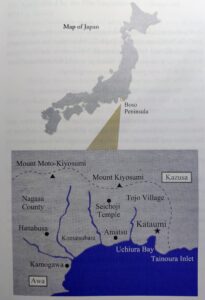
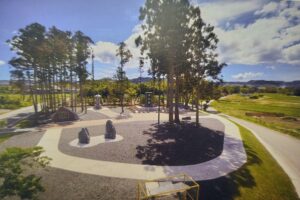
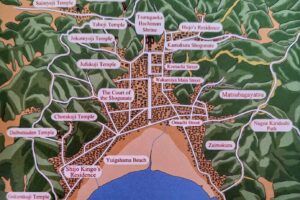
Kataumi is considered to correspond to current Kamogawa City in Chiba Prefecture. Nichiren Daishonin’s birthplace has traditionally been considered to be “Kominato.” However, the Daishonin describes his memories of the landscape around his childhood home in Reply to Nii ama gozen (Nii ama gozen-gohenji):
The beaches of Kataumi, Ichikawa, and Kominato…
(Gosho, p. 763)
Here he mentions Kataumi together with Ichikawa and Kominato. Furthermore, the existence of Kataumi, in addition to Kominato and Ichikawa, is confirmed through the local documents in this area. Therefore, Kataumi can be thought to be the name of a place or a village in the neighborhood of Kominato.
The name “Kataumi” existed until the early modern period. Over time, however, it fell out of use, and unfortunately, it is no longer possible to pinpoint its exact location.
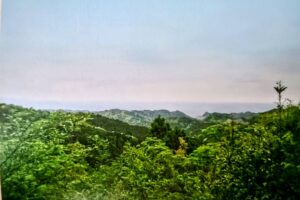
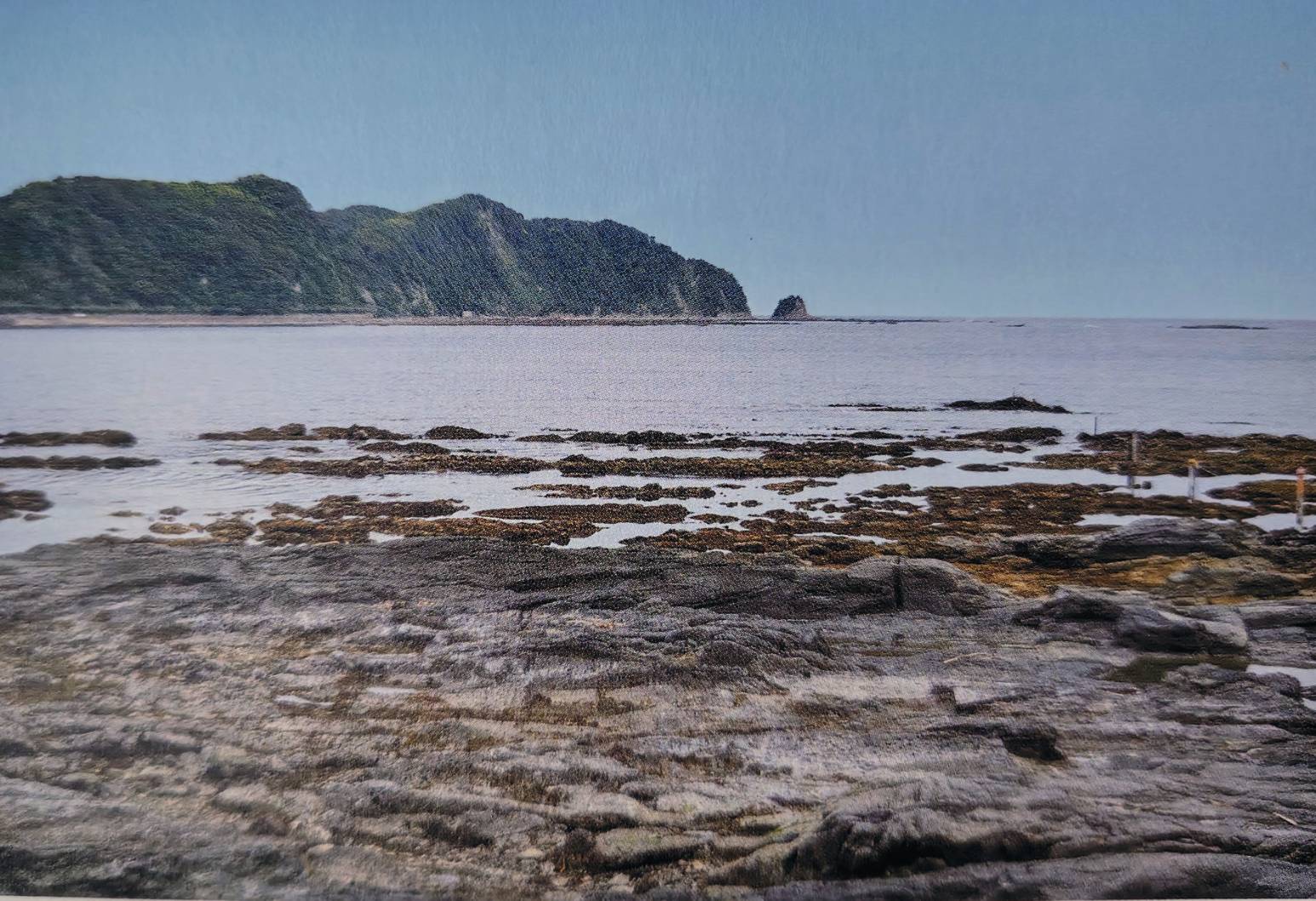
Nevertheless, it is a fact that Kataumi was the name of a fishing village that existed at Uchiura Bay to the south of Boso Peninsula, and this is considered to be Nichiren Daishonin’s birthplace. The area around Uchiura Bay overlooks the great Pacific Ocean, with the Seicho mountains rising from behind. It has a warm climate and is surrounded by scenic beauty.
Therefore, Kataumi is the perfect place where the True Buddha, who would save all living beings, was born.
The Age Defiled by the Five Impurities
Nichiren Daishonin made his advent in the first year of Jo-o (1222). This was the 2,171st year following Shakyamuni Buddha’s passing, and also marked the 171st year of the Latter Day of the Law.
In the Sutra of the Great Assembly (Daishik-kyo), Shakyamuni Buddha predicted the future of Buddhism:
The first Five-hundred-year Period after my death will be the age of emancipation, and the next Five-hundred-year Period will be the age of meditation, which will add up to one thousand years. The third Five-hundred-year Period will be the age of reading, reciting, and listening, and the next Five-hundred-year Period will be the age of building temples and stupas, which will account for two thousand years. The last Five-hundred-year Period will be the age of conflict within the teachings that I have expounded. This will cause the pure Law to become obscured and lost.
(Selected Gosho Passages of Nichiren Daishonin, p. 165)
The first thousand years after Shakyamuni’s death is called the Former Day of the Law. In this period, there were people who were freed from the state of delusion and reached the state of emancipation through Shakyamuni’s Buddhism.
The next thousand-year period is called the Middle Day of the Law. In this age, people respected the formalities of Buddhism and conducted recitations of the Buddhist sutras, listened to the Buddhist teachings, translated the scriptures, and built a large number of stupas and temples.
The last Five-hundred-year Period is called the Latter Day of the Law. Shakyamuni Buddha predicted that two thousand years after his passing, the world would enter the age of conflict, the people’s capacity would deteriorate, and Shakyamuni Buddha’s teachings would be obscured and lost.
This prediction came true. When Nichiren Daishonin made his advent, the entire world including Japan had become defiled by the five impurities, and tragedies caused by conflicts were proliferating.
In Japan it was a time of social upheaval: hierarchical relationships highly valued back in those days were destroyed, such as vassals overthrowing their lords and usurping their authority. This represents the chaotic condition of the Latter Day of the Law-the evil age defiled by the five impurities. This was clearly demonstrated by the occurrence of the unprecedented Jokyu Incident in the third year of Jokyu (1221), one year before the Daishonin’s birth. During this upheaval, the Kamakura Shogunate led by Hojo Yoshitoki and others, defeated the imperial court. This resulted in the banishment of the three retired emperors-Gotoba, Tsuchimikado, and Juntoku.
In Asia around 1206, Genghis Khan declared himself as the Khan or the emperor of the Mongolian Empire, after unifying the entire land of Mongolia. Immediately after, he launched massive invasions in every direction. His powerful mounted troops instantly conquered Central Asia. Within five decades, Genghis Khan had conquered the northeastern region of China, taking possession of the northern part of the Yellow River, and the Crimean Peninsula from the coast of the Black Sea to the Ukraine region. Thus, he created the largest empire in history. His invasions were relentless, and several million people were killed.
ーーーーーーーーーー
4 Five impurities: impurity of the age, impurity of desire, impurity of living beings impurity of view, and impurity of life, which are caused by the slander of true Buddhism. They are stated in the Expedient Means (Haben, second) chapter of the Lotus Sutta.
ーーーーーーーーーー
These invasions did not cease even after the death of Genghis Khan in 1227. The Mongolian Empire vanquished various countries in Eastern Europe, including Hungary and Poland, and in the Mediterranean region from Turkey to Iran. The Mongols dominated a huge territory. The western European countries were so terrified that in 1245, the Pope sent a goodwill envoy to Mongolia as a representative of those countries. Further, in the Far East, Kublai Khan, the fifth emperor, subjugated Tibet and forced Goryeo (which corresponds to the current Korean Peninsula) to surrender. In 1271 he gave the name, Yuan to all the countries that had been conquered, and finally defeated Southern Sung in 1279, completing the unification of Chinese land under the rule of Yuan.
During the thirteenth century, the world experienced an era of invasions and mass killings. This, indeed, proves that the age of conflict predicted by Shakyamuni Buddha truly had arrived.
Kamakura Shogunate
Upon the demise of the retired Emperor Goshirakawa in the thir year of Kenkyu (1192), Minamoto Yoritomo was appointed as th great general who would subdue the barbarians, a position that b long had yearned for. With this, the military rule of the Kamakur Shogunate in Japan was born in name and in reality.
For 30 some years leading up to the establishment of th shogunate, there had been continuous bloody conflict, with th strong devouring the weak. Still, this did not change even after t establishment of the shogunate.
Each time a battle occurred, the general population had to suf from serious hardships, all they could do was to helplessly endure.
The rule of the Minamotos, who had seized power, came to an end after only three generations. Ultimately, political power fell into the hands of the Hojo clan,’ who had served in the office of the regent. At that time, the de facto, supreme ruler was Hojo Yoshitoki. who was then acting as the regent. He reinforced his control over the manors owned by the immediate vassals of the shogun, expanding the actual power of the government.
The nobles of the imperial court saw the rights of their manors gradually taken away by the immediate vassals of the shogun. resulting in a significant diminishment of their political power and economic base.
This was a matter of life and death for the members of the aristocracy, mainly for the imperial family. After the death of the third shogun, Sanetomo, the retired Emperor Gotoba determined the time was right for him to recover the power of the imperial court by taking advantage of the political strife within the government. He devised various schemes. In particular, Gotoba demanded that Yoshitoki return to him the power to appoint and remove the estate stewards, since the shogunate still held that power. Yoshitoki, however, rejected Gotoba’s proposal. In fact, Yoshitoki sent his brother, Tokifusa, together with a large military display of 1.000 soldiers, to Kyoto, then the capital, to deliver his message to Gotoba Yoshitoki also repeatedly forced a prince of Gotoba to travel from
ーーーーーーーーーー
5 The Hojo clan: The clan that continued to have real power in the Kamakura Shogunate during the Kamakura period from around 1192 to 1333.
6 The retired Emperor Gotoba [1180-1239]: The 82nd emperor of Japan, a fourth prince of Emperor Takakura. He became emperor in 1183 by the retired Empetor Goshirakawas order. Although he abdicated the throne to Emperor Tsuchimikado in 1198, he ruled Japan during the reigns of Emperor Tsuchimikado, Juntoku, and Chukyo. In 1221 Emperor Gotoba issued an imperial order to subjugate Hojo Yoshitoki and took up arms against him This is called the Jokyu Incident. However, he was defeated by Yoshitoki and banished to Oki Island, where he passed away.
ーーーーーーーーーー
Kyoto to Kamakura so that Yoshitoki could take advantage of the authority of the imperial court by having Gotoba’s son assume the position of shogun. However, Gotoba also rejected this idea. In the end, there was no other choice for both parties but to settle the dispute through armed conflict.
Jokyu Incident
Finally, on May 15th in the third year of Jokyu (1221), the Imperial Court issued a command in the name of the retired Emperor Gotoba ordering that Hojo Yoshitoki and his followers be subdued; this was the beginning of the Jokyu Incident. However, the Kamakura Shogunate amassed 190,000 soldiers and completely overwhelmed the army of the retired Emperor. In only a month’s time, this Jokyu Incident quickly ended with the Kamakura Shogunate’s complete victory.
The Record of the Jokyu Incident (Jokyu ki) states that Kyoto was driven into a state of hell by the soldiers of the Kamakura Shogunate, who plundered it, set buildings on fire, and attacked and massacred the people there.
After the Jokyu Incident, Yoshitoki banished the retired Emperor Gotoba to Oki Island, the retired Emperor Juntoku to Sado Island, and the retired Emperor Tsuchimikado” to Tosa Province. Moreover,
ーーーーーーーーーー
7 The retired Emperor Juntoku [1197-1242]: The 84th emperor of Japan; the third prince of Emperor Gotoba. He became emperor when his father forced Emperor Tsuchimikado to etire in 1210, In 1221, he abdicated the throne to his son, who became Emperor Chukyo, mor the purpose of joining his father in the battle during the Jokyu Incident. As the army f the retired Emperor Gotoba was defeated, the retired Emperor Juntoku was banished to ado Island, where he passed away in 1242.
8 The retired Emperor Tsuchimikado (1195-1231]: The 83rd emperor of Japan; the first rince of Emperor Gotoba. He became emperor in 1198 and retired in 1210. He tried to stop his father from subjugating the Hojo clan. Thus, he escaped from being tanishod be the Kamakura Shogunate, but he voluntarily requested to be banished to what is cuand Kochi Prefecture. Later, he was transferred to what is currently Tokushima Prefecture, whate he passed away in 1231.
ーーーーーーーーーー
he ordered the beheading of the main aristocrats and samurai warriors who had joined the retired Emperor Gotoba’s faction opposing the shogunate.
The Jokyu Incident was be a watershed in Japanese history. This marked a change in the unprecedented and is considered to governnance structure of the Japanese government, from aristocran and court nobles to samurai warriors, who before had been vassaly of the Imperial Court. This political upheaval, with the subordinates overthrowing their superiors, represents the state in the Latter Day of the Law, defiled with the five impurities.
It was during this age of conflicts and wars when Nichiren Daishonin was born, because the True Buddha felt it was time to make his advent in this age of extreme conflict and anger. Here, we can see a profound causal relationship in this world from the Buddhist point of view.
Determination and Pursuit of Learning
When Zennichimaro was very young, there was an increasing concern about the state of society, due to tragic incidents occurring one after another, as well as serious famines caused by natural disasters, such as heavy storms and droughts. Young Zennichimaro was very bright, and he came to consider the question of what was the cause of these various misfortunes, including the Jokyu Incident. In order to resolve such confusion in society, at the age of 12, in the first year of Tempuku (1233) he decided to pursue learning in order to become “the wisest man in Japan.” He then started his tudies under Dozen-bo at Seichoji Temple near Kataumi. There, e learned general knowledge and reading and writing, focusing on Buddhist scriptures. He was tutored mainly by his seniors, Joken-o and Gijo-bo.” Because of his innate talent and seeking spirit, he more and more deepened his understanding. As time progressed, he questions that he had been vaguely contemplating all along, radually became clear in his mind.
First, during the Jokyu Incident, the emperor’s side exhausted their energy praying for the defeat of the opponent. Prayers were ffered by prominent monks, such as those from the Tendai and hingon sects, which claim to protect and keep the nation tranquil. espite this, they suffered a crushing defeat, resulting in the anishment of the three retired emperors. Why did this happen?
Second, why is it that devoted Nembutsu believers in Awa ovince showed signs of agony at the time of death, indicating that ey had fallen into the evil paths?
Third, Shakyamuni Buddha’s true intention must have been to pound only one fundamental teaching. However, why is it that his aching was divided into multiple schools of thought, each of which sisted on its own superiority?
ーーーーーーーーーー
9 Dozen-bo [?-1276]: A priest of Seichoji Temple. Nichiren Daishonin’s master when he red the priesthood.
10 Seichoji Temple: A temple located in the area currently known as Kiyosumi, Kamogawa of Chiba Prefecture. At this temple, Nichiren Daishonin studied in his youth, entere priesthood, and later, gave his first sermon.
11 Joken-bo and Gijo-bo [Dates of birth and death unknown]: Two priests who wen hiten Daishonin’s seniors who mentored him at Seichoji Temple. Later, they embrace Daishonin’s Buddhism.
ーーーーーーーーーー
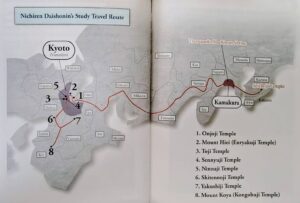
Entering the Priesthood and Study Travels
When Zennichimaro was sixteen years old, he entered th priesthood and changed his name to Zesho-bo Rencho. He wante to master the essence of Buddhism and find the answers to th questions he had. He assiduously devoted himself to his dail practice and study day and night.
Rencho thoroughly read all of the scrolls of the sutras and othe writings possessed by Seichoji Temple. In the spring, two yeam after he entered the priesthood, Rencho set out on a journey visit various temples in Japan with the determination to further h studies. It took him as long as 14 years to complete his studies.
Later, the Daishonin stated in Reply to Myoho bikuni (Myoh bikuni-gohenji):
I went to Kamakura, Kyoto, Mount Hiei, Onjoji Temple Mount Koya, Tennoji Temple and elsewhere, mastering thei respective doctrines, at temple after temple, in province afte province.
(Gosho, p. 1258)
Seeking the many Buddhist scriptures and writings, he visite Kamakura, the center of politics and finance, and historic temples such as Enryakuji Temple on Mount Hiei, the center of Buddhism a that time.
During his long years of study, he came to the following conclusions:
First, the various sects that went against Shakyamuni Buddha’s fundamental doctrines were the cause of all the disasters.
Second, the Law that should be propagated in the Latter Day of the Law is the five characters of Myoho-Renge-Kyo, which is the essence of the Lotus Sutra.
And finally, he awakened to the realization that he, himself, was the reincarnation of Bodhisattva Jogyo (Superior Practice), who will save the people in the impure age of the Latter Day of the Law, based on the five characters of Myoho-Renge-Kyo.