The Third Remonstration with the Nation
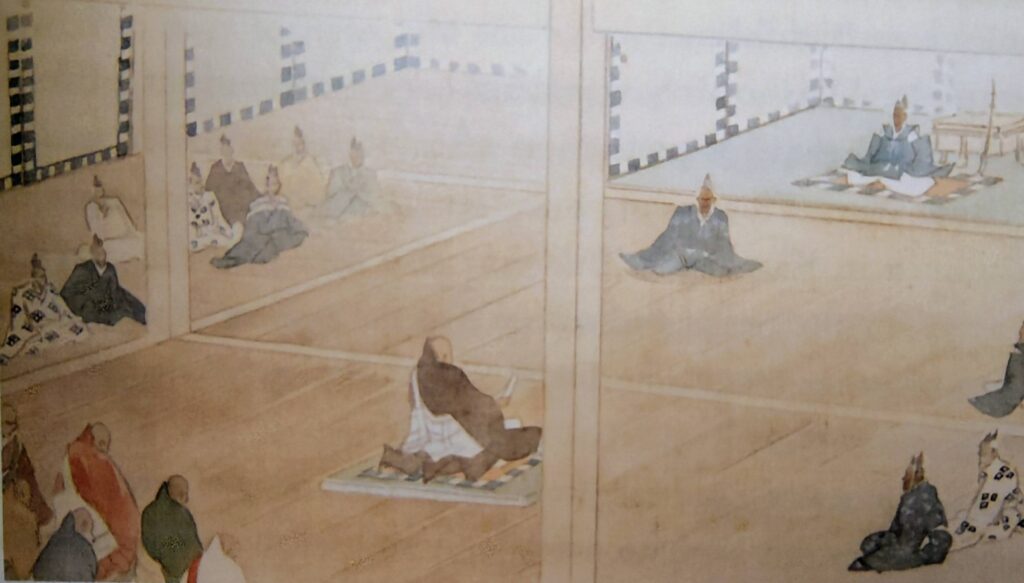
On April eighth in the 11th year of Bunnei (1274), Nichiren Daishonin met with Hei-no saemon-no-jo Yoritsuna and several other Kamakura government officials.
Although Hei-no saemon-no-jo had taken a threatening attitude toward Nichiren Daishonin during the Tatsunokuchi affairs, this time, he welcomed the Daishonin with a gentle demeanor. He asked some questions, including the possibility of attaining Buddhahood through the pre-Lotus Sutra teachings, and the timing of the Mongol attack.
Nichiren Daishonin replied that the Buddhist sects based on the pre-Lotus Sutra teachings could not lead their followers to attain Buddhahood. He also admonished them, stating that, if the Kamakura government continued its policy of ordering the priests of the Shingon sect to offer prayers for protection from the Mongo invasion, Japan would fall into decay without fail. The Daishonin further warned that since the guardian deities obviously wer angry, it was certain that the Mongol attack would occur within the year The Daishonin therefore admonished Hei-no sacmon-no-jo to immediately discard all erroneous doctrines and embrace the Daishonin’s true Buddhism.
Among the Daishonin’s warnings, the government officials were only afraid that his prediction of a foreign invasion actually would come true. They made an offer to establish a temple for the Daishonin in Kamakura. But they also asked him to agree to offer prayers for the peace and security of the nation together with the priests of other sects. The Daishonin completely rejected their proposal.
The Daishonin had no desire for fame or the power of government patronage. Rather, his aspiration was only to lead the people to take faith in the true Law and realize a peaceful land by vanquishing the cause of misfortune, that is, heretical teachings.
Kaga-no-hoin’s Prayer for Rain
Having seen the hopeless situation in which the wells had dried up and the crops had withered due to frequent droughts, the Kamakura government decided to take measures by ordering Kaga-no-hoin, the chief priest of the Amidado Hall in Kamakura, to conduct a ritual prayer for rain, despite the Daishonin’s third remonstration that the government should never order or request prayers to be made by the Shingon sect.
This priest was a high-ranking monk, enjoying the greatest prestige at that time. As the principal scholar of Toji Temple, the central temple of the Shingon sect in Kyoto at that time, he was said to have mastered the secret arts of the Shingon sect and to have thoroughly learned various other teachings, such as Kegon and Tendai.
On April tenth of the 11th year of Bunnei (1274), Kaga-no-hoin started to pray for rain. On the following day, it started to rain. All day long, there was no wind blowing and the rain quietly continued.
Hojo Tokimune, the regent of the Kamakura government, was so impressed that he gave the monk a variety of rewards, such as gold and horses.
Thus, all the people in Kamakura mocked the Daishonin, and said, “Although Nichiren was about to be beheaded due to the propagation of his incorrect teachings, he luckily survived. Despite that, he continues to slander the Nembutsu and Zen sects rather than conduct himself properly. He is even slandering the Shingon sect. This time, the prayer for rain came true with the Shingon esoteric teaching. This serves as a good example of its power. Nichiren’s doctrines were defeated, and the Shingon sect won a victory.”
Even some of the Daishonin’s disciples began to harbor doubts. They wondered, “Our master insists that prayers for rain based on the teachings of Shingon never will be answered, but his teaching might be wrong.” Upon hearing this, the Daishonin explained to them as follows:
If the evil doctrines of Kobo41, who is revered as a great teacher in the Shingon sect, were true and prayers based on his teachings were beneficial for the nation, then Emperor Gotoba, who was exiled to Oki Island, should have been victorious during the Jokyu Incident. Kobo wrote in the Treatise of the Ten Stages of the Mind (Ju jushin-ron) that the
ーーーーーーーーーー
41 Kobo [774-835]: Also known as Kukai or the Great Teacher Kobo, who founded the Shingon sect in Japan. The Daishonin refuted this sect, saying. “Shingon will ruin the Ration
ーーーーーーーーーー
Lotus Sutra is inferior even to the Flower Garland Sutra to the Secret Treasury (Hizo Moreover, in The Precious Key hoyaku) he stated that Shakyamuni Buddha, who is described in the furye chapter of the Lotus Sutra, is nothing but a common mortal. He called the Great Teacher Tiantai42 a thief. and furthermore claimed that the Buddha who preached the Lotus Sutra, the teaching of the one vehicle of Buddhahood, was inferior even to the sandal-bearer of Great Sun Tathagata43 Kaga-no-hoin is a disciple of Kobo, who taught these heretical doctrines. How could he possibly defeat me in a challenge to pray for rain? If he could do that, then the Dragon King, who brings forth the rain, would become an enemy of the Lotus Sutra. He would be strictly punished by the Heavenly Kings Daibon and Taishaku44” and the Four Heavenly Kings45. Thus, there must be a deep reason for this appearance of rain.
(Gosho, pp. 1068-1069 [Summary])
ーーーーーーーーーー
42 The Great Teacher Tiantai [538-597]: A Chinese priest during the Chen and Sui dynasties, who was the founder of the Tiantai sect in China and established its doctrines based on the Lotus Surra. His lectures were recorded in the three major writings of the Tiantai sect: Profound Meaning of the Lotus Sutra (Hokke gengi). Words and Plorases of the Latur Sure (Hokke mongu), and Great Concentration and Insight (Maka shikan).
43 The Great Sun Tathagata: The Buddha who appears in the Great Sun Tathagata Sutra (Dainichs-kyo) and other sutras. He is considered to be the most important Buddha in the esoteric Shingon teachings
44 The Heavenly Kings Daibon and Taishaku: The guardian deities who vowed to protect Buddhism as well as the votaries of the Lotus Sutra in the Latter Day of the Law.
45 The Four Heavenly Kings: The Heavenly King of the East (Jpn. Jikokusen. Skt. Dersaraibera), the Heavenly King of the West (Jpn. Komokuten, Skt. Virupakshal, the Heavenly King of the North (Jpn. Bishamonten, Skt. Vindnessuna), and the Heavenly King of the South (Jpn. Zachoten, Sks. Virudhaka).
ーーーーーーーーーー
On April 12th, soon after the Daishonin gave this explanation, it stopped raining, and violent winds suddenly began to blow. Both
small and large houses, temple halls and pagodas, big trees, the government buildings, and so on, were destroyed by the gale force winds. A huge luminous orb flew through the sky. Many people and animals, such as oxen and horses, were killed by the powerful winds. It was unprecedented for such strong gales to appear at that time of year, which was not the typhoon season in Japan. Moreover, the storms did not blow throughout Japan, but only in the eight provinces of the Kanto region. It is said that the winds blew harder in Sagami Province than in the other seven provinces, and within Sagami Province, they blew most forcefully in Kamakura. And within Kamakura, the winds blew even more intensely at the government buildings, Tsurugaoka Hachiman Shrine, Kenchoji Temple, and Gokurakuji Temple.
Regarding this tragic phenomenon, the Record of the Nine Reigns under the Hojo (Hojo kudai ki), a historical document, states:
On the twelfth day in the fourth month of the eleventh year of Bunnei (1274), violent winds swept [the land) causing the plants and trees to die.
(The Collection of the Japanese Classics, the second series [Zoku gunsho ruiju), vol. 29-1, p. 425)
Nichiren Daishonin also refers to this tragedy in Repaying Debts of Gratitude (Ho-on-sho):
The violent wind on the twelfth day of the fourth month in the eleventh year of Bunnei (1274) blew against the prayer for rain offered by Kaga-no-hoin, who is the chief priest of the Amidado Hall, and is called the wisest person of Toji Temple. He must have received the transmission of the evil Law without any changes from Shan Wu Wei46, Vajrabodhi47 and Amoghavajra48.”
(Gosho, p. 1024)
This was actual proof of the failure of Kaga-no-hoin’s prayer for rain. In fact, his prayers brought about tragic and disastrous results, and Kaga-no-hoin’s disciples who ridiculed the Daishonin were exposing the fallacy of Shingon prayers. The people of Kamakura now left dumbfounded after witnessing such a tragic result, and the Daishonin’s disciples also were stunned by the fact that his prediction came true. He stated the following in the Gosho, On Establishing the Hachiman Shrine (Hachimangu zoei no koto):
On the twelfth day of the fourth month in the eleventh year of Bunnei (1274), a violent wind blew. This was an omen indicating that the invasion from foreign lands would occur later that same year. The wind is an envoy of the heaven and the earth. This is what is referred to as, “when the politics are rough, the winds get rough.”
(Gosho, pp. 1557-1558)
The Daishonin declared that this violent storm was an omen of the invasion of Japan by the Mongols.
ーーーーーーーーーー
46 Shan Wu Wei (637-735): A priest from India. His Sanskrit name was Subhakarasimha He first introduced the esoteric Shingon teachings to China. One of the three Tripitaka masters referred to in the Gosho along with Vajrabodhi and Amoghavajra.
47 Vajrabodhi [669-741]: A priest from India. One of the three Tripitaka masters who established the foundation of the esoteric Shingon teachings in China.
48 Amoghavajra [705-774]: A priest of the esoteric Shingon teachings in China. A disciple of Shan Wu Wei. One of the three Tripitaka masters.
ーーーーーーーーーー
He also stated:
The Kamakura Shogunate should never order the monks of the Shingon sect to incant a spell for the Mongols to perish. If they do, the nation will fall to ruin even more quickly…Judging by the signs from the heavens, which show the guardian deities becoming increasingly furious, it will not be long before the Mongols arrive and invade the land. The invasion is likely to happen before the end of this year.
(The Selection of the Time [Senji-sho], Gosho, p. 867)
The Daishonin’s prophecy came true as forewarned to Hei-no saemon-no-jo, and in October of the same year (1274) a large Mongolian army attacked Japan. This was an unprecedented incident called the “Battle of Bunnei.”
Entering Mount Minobu
Nichiren Daishonin remonstrated with the Kamakura government three times up until then, but his remonstrations were not heard. Therefore, in May of the 11th year of Bunnei (1274), at the age of 53, Nichiren Daishonin went to Mount Minobu to take up residence, following the words of an old proverb49, which stated, “If a sage remonstrates with the sovereign three times, and his remonstrations are not heeded, the sage should retire to a mountain.”
ーーーーーーーーーー
49 An old proverb: Quoted in Goshos, such as Repaying Debts of Gratitude (Ho-on-sho). The Book of Rites (Rai ki) in ancient China states, “If one remonstrates with the sovereign three times, and his remonstrations are not heeded, he should leave the sovereign.”
ーーーーーーーーーー
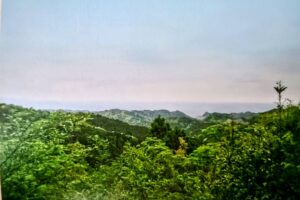
Minobu was located in Kai Province (currently Yamanashi Prefecture). It was a secluded area, surrounded by towering mountains. The lord of Minobu was Hakiri Sanenaga50, who was led to Nichiren Daishonin’s Buddhism by Nikko Shonin.
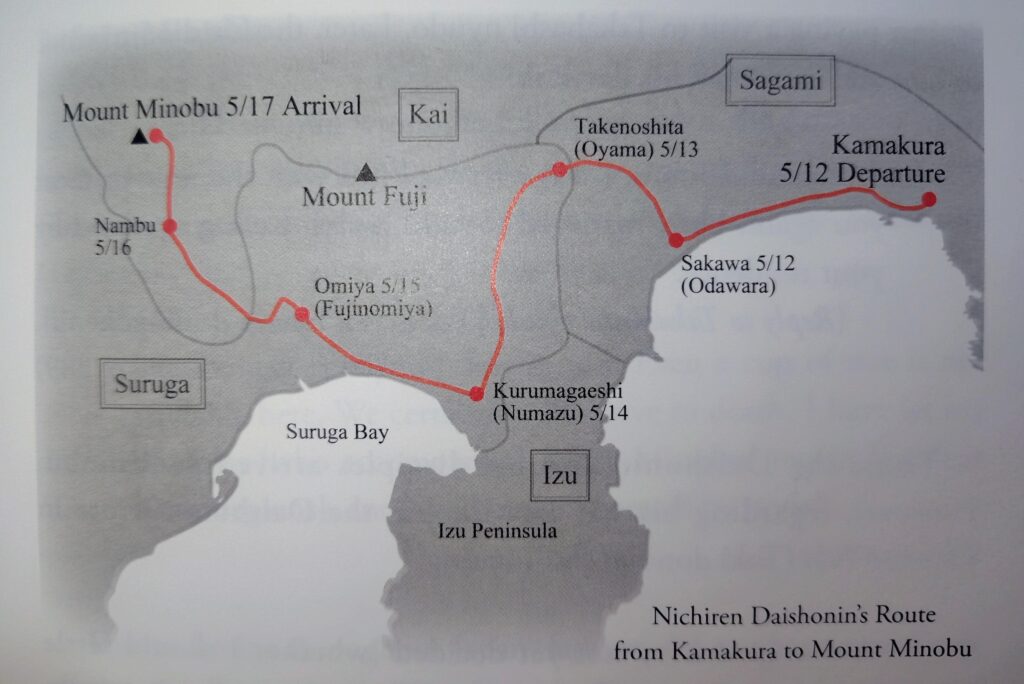
The Daishonin described his journey from Kamakura to Minobu in the Letter to Toki (Toki dono-gosho):
We stayed at Sakawa on the twelfth day [of the fifth month], Takenoshita on the thirteenth day, Kurumagaeshi on the fourteenth day. Omiya on the fifteenth day, and Nambu on the sixteenth day. Then, we finally reached this place (the manor of Hakiri Sanenaga) on the seventeenth day.
(Gosho, p. 730)
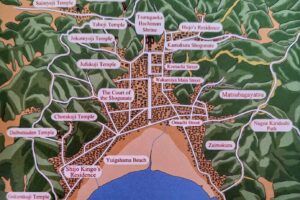
We can have a better understanding of the Daishonin’s journey if we use the current names of the places he passed through. We would say that after departing from Kamakura, he stayed at the following locations:
May 12th: Sakawa in Odawara City in Kanagawa Prefecture
May 13th: Takenoshita near the current Ashigara Station in Sunto County in Shizuoka Prefecture
May 14th: Kurumagaeshi near the Sammaibashi in Numazu City
May 15th: Omiya (currently Fujinomiya City)
May 16th: Nambu in Minamikoma County in Yamanashi Prefecture
May 17th: The residence of Hakiri Sanenaga in Hakiri Village
ーーーーーーーーーー
50 Hakiri Sanenaga [1223-1297]: Also called Nambu Rokuro Saburo. Since his inherited estate was called Nambu, he took it for his family name. Nikko Shonin led him to embrace Nichiren Daishonin’s Buddhism. He donated the land for Minobu-san Kuonji Temple to Nichiren Daishonin. After the Daishonin’s passing, he committed many slanderous acts against the Law, causing Nikko Shonin to leave Mount Minobu.
ーーーーーーーーーー
Along the way, the Daishonin was eager to see Takahashi nyudo,51 one of Nikko Shonin’s relatives, who lived in Kashima in Fuji Cou (currently Fuji City). He was a faithful believer and also a key per among the lay believers in the region. The Daishonin trusted H deeply and was looking forward to meeting him again.
However, the region was under the jurisdiction of the ma lineage of the Hojo clan. The mother of Hojo Tokimune wa dedicated follower of Ryokan of Gokurakuji Temple, and she great influence in the region. The Daishonin was concerned his stay would bring trouble to the Takahashi family, so he decided
ーーーーーーーーーー
51 Takahashi nyudo [Dates of birth and death unknown]: Takahasi Rokuro Hyoe ny One of the followers during Nichiren Daishonin’s lifetime. He was one of the imme vassals of the Kamakura Shogunate, who lived in Kashima in Fuji County of St Province (currently Motoichiba in Fuji City, Shizuoka Prefecture). It is said that he faith in Nichiren Daishonin’s Buddhism through shakubuku by Nikko Shonin who w relative. He was given the Goshos, such as Reply to Takahashi nyudo (Takahashi nyudo gohenji).
ーーーーーーーーーー
against paying a visit to Takahashi nyudo. Later, the Daishonin wrote to him and explained his decision:
A thousand times, I was overwhelmed with the urge to meet you again, but I managed to hold myself back and passed by your residence.
(Reply to Takahashi nyudo [Takahashi nyudo dono-gohenjil,Gosho, p. 889)
Thus, the Daishonin and his disciples arrived at Minobu. However, regarding his stay in Minobu, the Daishonin wrote in Letter to Toki (Toki dono-gosho), stating:
Although I have not yet decided [whether I should settle down here or not), the circumstances in this mountain mostly satisfy my requirements. Therefore, I will stay here for now.
(Gosha, p. 730)
Also, in another Gosho, Letter to Shimoyama (Shimoyama-goshosoku), he stated:
I entered this mountain to stay for the time being.
(Gosho, p. 1153)
We can see from these passages that the Daishonin had no intention to stay in Minobu permanently. The Daishonin only agreed to follow Nikko Shonin’s suggestion to go to Minobu. Although in later ages the other Nichiren sects insist that Minobu is the center of the Daishonin’s Buddhism, it is obvious from these passages that this interpretation does not reflect the Daishonin’s true intention.
Life in Minobu
Nichiren Daishonin wrote the following about the situation when he began to live in Minobu in the postscript to the Letter to Toki (loki dono-gosho), which was written in the 11th year of Bunnei
(1274):
Our hunger is beyond description. Even a cup of rice is not available here. We certainly will starve to death. I have let my disciples [who accompanied me to Minobu) return [to their home regions), and I will remain here all by myself.
(Gosho, p.730)
Due to famine throughout Japan, farmers did not have even a cup of rice to sell to anyone. Therefore, the Daishonin and his disciples had to even worry about starving to death. We can understand the gravity of the hardships the Daishonin was facing in Minobu by the fact that he had to let most of his disciples return to their respective home regions.
Moreover, they had to endure the cold of severe winters. Even though lay believers from around the country sent offerings of food and other necessities to the Daishonin, it was not quite enough to support him and a number of his disciples, so they were forced to live frugally in Minobu.
Nichiren Daishonin described the conditions of his life in Mount Minobu as follows:
I kept myself alive by eating snow as Su Wu52 did, and I survived
ーーーーーーーーーー
52 Su Wu [140 BCE-60 BCE): One of the vassals of the Former Han dynasty in ancient China. He was caught by and became a prisoner of the Xiongnu, but he did not give in to their oppression and remained loyal to his sovereign. His story is referenced in several Gothos
ーーーーーーーーーー
[in a mountain] by wearing a straw cape as Li Ling53 did. When I could not collect anything in the forest, I subsisted without eating anything for three days. When my deerskin coat tore, I had no adequate clothing for three or four months.
(On Offering of an Unlined Cloth [Tanne-sho], Gosho, p. 904)
Here on Mount Minobu, there are many stones, but no rice cakes. Moss is plentiful, but there is nothing to use as a floor covering. (Offering of Three Straw Mats [Mushiro sammai-gosho],
Gosho, p. 1592)
ーーーーーーーーーー
53 Li Ling[?-74 BCE]: One of the generals of the Former Han dynasty in ancient China. He defeated an army of the Xiongnu with a small number of soldiers, but ultimately surrendered to them. Later on, he died in the territory of the Xiongnu. His story is referenced in Goshos such as Letter to Ko ama (Ko ama gozen-gosho).
ーーーーーーーーーー
Two years after entering Minobu, in the second year of Kenji (1276), he wrote the following in On Leaving the Sutra Book Behind (Bojikyo ji):
The sound of the recitation of the Lotus Sutra reverberates through the blue sky, and the words of the lectures on the one vehicle echo in the mountains.
(Gosho, p. 957)
We can see that the Daishonin spent his daily life in Minobu reciting the Lotus Sutra together with his disciples and lay believers, giving them lectures.
Furthermore, according to the Gosho, Reply to Hyoe-sakan (Hyoe sakan dono-gohenji), by the first year of Koan (1278), there were at least 40 to a maximum of 60 people staying in the vicinity of the Daishonin’s hut, seeking his guidance and devoting themselves to the practice and study of his Buddhism. In this manner, the Daishonin’s hut turned into a lively place with more and more of his disciples and believers visiting him.
This is described in Reply to Soya (Soya dono-gohenji), written in August of the second year of Koan (1279), which states:
This year, I support more than 100 disciples and believers in this mountain. I have them read the Lotus Sutra, and I expound to them on the teaching of the sutra all day long.
(Gosho, p. 1386)
Many people who had any relationship with the Daishonin’s disciples or believers revered him and came to see him. The number of visitors sometimes swelled to more than 100. Furthermore,some people, including a Nembutsu priest in Shimoyama named Nichiei, tried to listen to his preaching secretly, as written in Letter to Shimayama (Shimoyama-goshosoku):
Someone sneaked into my dwelling and eavesdropped my lecture behind others….
(Gosho, p. 1137)
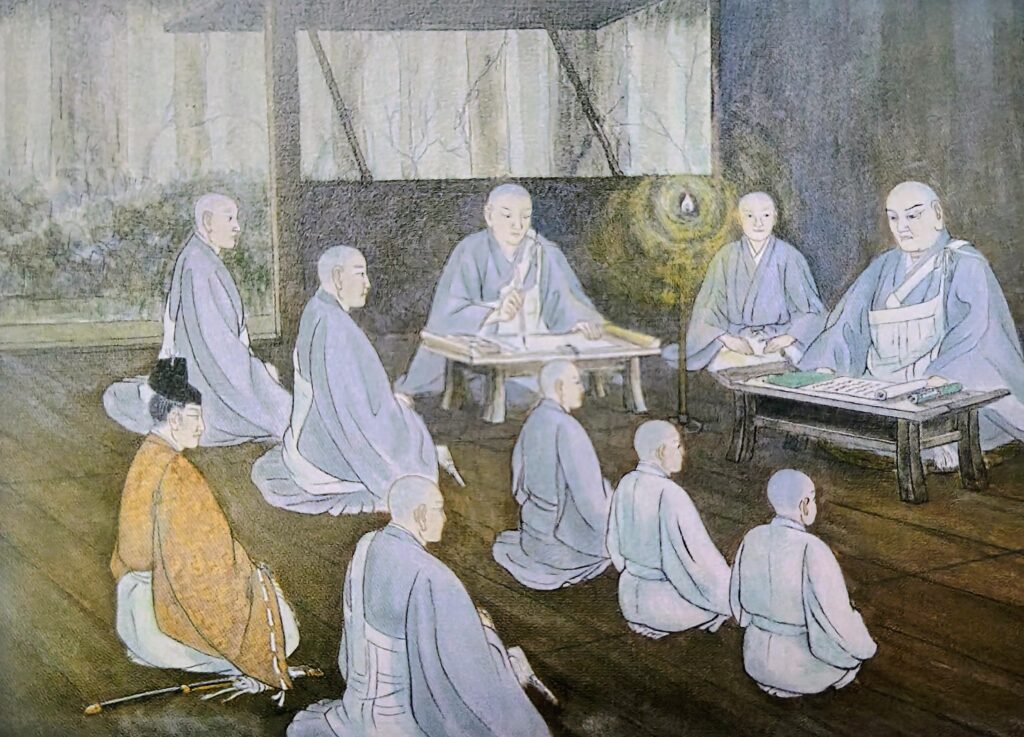
Under these circumstances, the Daishonin wrote doctrinal documents and other writings in Mount Minobu. The Essentials of the Lotus Sutra (Hokke shuyo-sho) was especially significant. In this Gosho, he revealed for the first time, the name and composition of the Three Great Secret Laws: the True Object of Worship of the Essential Teaching, the High Sanctuary of the Essential Teaching, and the Daimoku of the Essential Teaching.
In November of the second year of Kenji (1276) Nichimoku Shonin, who later became the Third High Priest, visited NichirenDaishonin at the age of 17 and began to constantly serve the Daishonin. He had become a disciple of Nikko Shonin in Enzobo Temple in Izu Province in April of the same year.
While chanting Daimoku and reciting the Lotus Sutra, in order to repay the four debts of gratitude54, Nichiren Daishonin, in Minobu, educated his disciples and laid the foundation for the perpetuation of the Law and the achievement of kosen-rufu.
Orally Transmitted Teachings (Ongi kuden) and Recorded Lectures (Onko kikigaki)
Nichiren Daishonin preached to the priests and lay believers on the true meaning of the Lotus Sutra, which he had revealed at the risk of his life through undergoing the persecutions as predicted in the sutra. His lectures included not only interpretations of the words and phrases of the Lotus Sutra, but also the profound doctrine from the standpoint of the True Buddha in the Latter Day of the Law. Each word and phrase that the Daishonin expounded jolted their spirits, as they etched the teachings firmly and deeply into their hearts.
However, it was not easy for everyone to understand the profound significance of the Daishonin’s lectures, which reveal the Buddhism of the sowing hidden in the depths of the Lotus Sutra.
Nikko Shonin was the only one who was able to comprehend the deep meaning of the Daishonin’s teachings, since he completely and perfectly understood the Daishonin’s true intention through his many years of serving the Daishonin, faithfully and constantly.
ーーーーーーーーーー
54 Four debts of gratitude: Debt of gratitude owed to one’s parents, all living beings, one’s sovereign, and the three treasures.
ーーーーーーーーーー
Nikko shonin recorded in writing the Dishonin’s lectures as the Orally Transmitted Teachings(Ongi kuden).
With regard to this socument, in the document , in The History of the Fuji School (kechu-sho)55 , High Preist Nissei Shonin56 wrote the following the passage:
After Nichiren Daishonin took up residence in Mount Minobu, he gave lectures on the Lotu Sutra in response to a request from his disciples. Although the Daishonin had a large number of disciples, he chose Nikko Shonin as his foremost disciple. Following the example of the Great Teacher Zhangan57, who documented the lectures on the Lotus Sutra and several other sutras given by the Great Teacher Tiantai, Nikko Shonin transcribed the Daishonin’s lectures, which amounted to 229 articles. He compiled these articles together with other teachings that he heard whenever the Daishonin gave a lecture. This compilation is called the Records Compiled by Nikko (Nikko ki).
(Seiten, p. 766)
ーーーーーーーーーー
55 The History of the Fuji School (Kechu-sho): A writing by the Seventeenth High Priest Nissei Shonin of Head Temple Taisekiji. It includes the achievements and biographies of the successive High Priests and other leading priests in the early period of Nichiren Shoshu.
56 Nissei Shonin [1600-1683]: The Seventeenth High Priest of Head Temple Taisekiji, who established the Nitemmon Gate and reconstructed the Micido. After having heard Nissei Shonin’s sermon, the future Twenty-sixth High Priest Nichikan Shonin entered the priesthood
57 The Great Teacher Zhangan [561-632]: The second patriarch of the Tiantai sect in China. A disciple of the Great Teacher Tiantai. In order to hand down Tiantai’s teachings to future generations, he transcribed and compiled Tiantai’s lectures, which were later referred to as the three major writings Profound Meaning of the Lotus Sutra (Hokke gengi), Words and Phrases of the Lotus Sutra (Hokke mongu), and Great Concentration and Insigin (Maka shikan).
ーーーーーーーーーー
As indicated here, Nikko Shonin transcribed the important lectures on the Lotus Sutra that the Daishonin gave from the andpoint of the True Buddha. This document was reviewed and approved by the Daishonin.
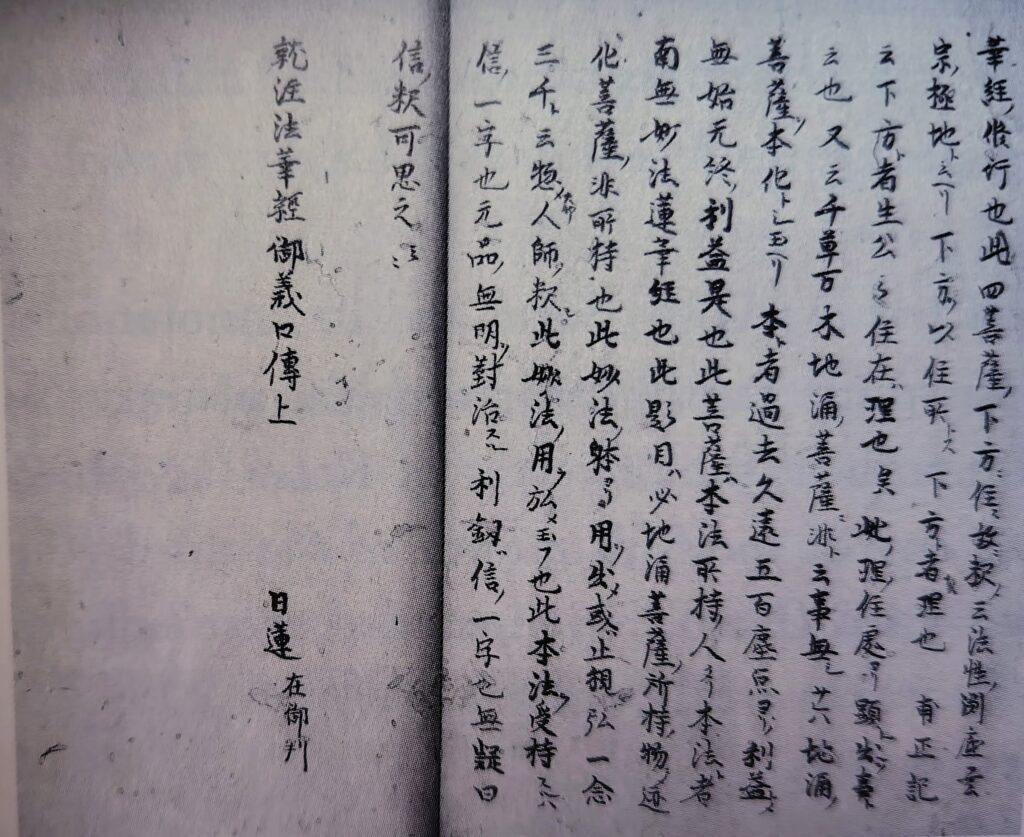 Orally Transmitted Teachings (handwritten copy, stored at Head Temple Taisekiji)
Following the same style as that of the Orally Transmitted Teachings, Mimbu Niko58” also transcribed the Daishonin’s lectures. That document is called the Recorded Lectures (Onko kikigaki) or the Records Compiled by Niko (Niko ki). Compared to the Orally Transmitted Teachings, this transcription does not fully describe the profound meaning hidden in the depths. It is, however, a valuable document that serves as a transcript of the Daishonin’s lectures, Since ancient times, there has been a debate as to whether or not these two documents recorded identical lectures given by the Daishonin.
ーーーーーーーーーー
58 Mimbu Niko [1253-1314]: One of the six senior priests appointed by Nichire Daishonin. Also called Sado-ko. After the Daishonin’s passing, he misled Hakiri Sanenag the lord of the Minobu region, into committing many slanderous acts, and caused Nikk Shonin to leave Mount Minobu.
ーーーーーーーーーー
Toward the end of the Orally Transmitted Teachings, it says:
The first day of the first month in the first year of Koan (1278)
Written by Nikko
(Gosho, p. 1815)
On the other hand, at the beginning of the Recorded Lectures, there is the following passage:
A series of lectures [on the Lotus Sutra and its annotations] were given [by Nichiren Daishonin] from the nineteenth day of the third month of the first year of Koan (1278) to the twenty-eighth day of the fifth month of the third year of Koan (1280). Thus, I (Niko) have recorded these lectures in writing.
(Gosho, p. 1818)
From this we can see that the Orally Transmitted Teachings is the compilation of lectures record-ed prior to January first of the first year of Koan (1278). This means that it is a record of all the lectures completed by the end of the previous year. By contrast, the Recorded Lectures is the compilation of lectures given between March of the first year (1278) and May of the third year of Koan (1280).
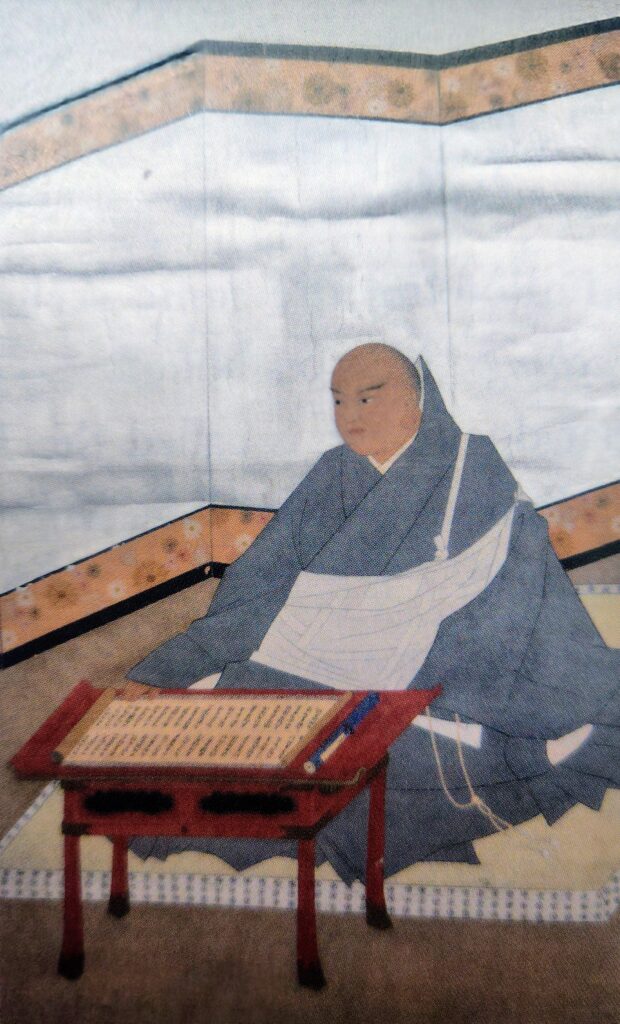 Nichiren Daishonin giving a lecture
Regarding the contents, there is a marked difference between the wo documents. It seems appropriate to conclude that the lectures themselves were different.
All things considered, it seems that the Daishonin gave lectures on the Lotus Sutra or its annotations two or three times at his dwelling in Mount Minobu. This is solely due to his great compassion to transmit the deep meaning of the true Law for the sake of his followers in his day as well as future generations.
Abutsu-bo and Sennichi ama (his wife)-Pilgrimages from Sado Island
There were two elderly believers from Sado who traveled all the way to Mount Minobu to visit the Daishonin in June of the eleventh year of Bunnei (1274). The Daishonin was so surprised to see them that he became almost speechless. They were Abutsu-bo and Ko nyudo, to whom he reluctantly bid farewell on Sado Island about three months earlier.
They had taken good care of the Daishonin, and when he left Sado, he thought that he never would see them again, since he had retreated deep into Mount Minobu. All he could do was worry about the old couples on Sado, with fond memories of them on the remote island. Because of this, he was overjoyed to see them, saying, “Is this a dream or an illusion?”
It seemed to have taken more than 20 days for Abutsu-bo and Ko nyudo to travel from Sado to Minobu. On their voyage, they took a great risk of being lost at sea, since they had to cross the raging Sea of Japan in a small boat. Moreover, if they had lost the opportunity to set sail on a clear day, they would have had to wait for days until the weather turned favorable. It was indeed a dangerous the constant threat of encountering pirates or bandits on theitay. Especially, due to their advanced age, they needed an even stronger determination.
To them, however, the distance to Mount Minobu was nothing Their desire to see and revere the Daishonin in person grew stronger and stronger each day. They became desperate to catch a glimpse of and serve the Daishonin even for a moment. Thus, they made a pilgrimage, single-mindedly yearning to see the Daishonin.
When they finally arrived at Minobu, the Daishonin gave them a sincere welcome. They certainly had a lively conversation with each other over the memories of their life on Sado. The Daishonin must have inquired about how Sennichi ama and Ko ama (the wife of Ko nyudo) were doing, since they were at home alone.
Abutsu-bo and Ko nyudo were filled with joy to have an audience with the Daishonin. Their prayer had been answered, dispelling all the hardships they had to undergo on their way.
The Daishonin wrote a letter to the wives of both Abutsu-bo and Ko nyudo, who continued to make tremendous efforts to see him. In his letter he not only praised Abutsu-bo and Ko nyudo for their determination, but also commended the firm faith of their wives, who had sent their precious husbands all the way to Minobu. He stated:
You have sent your precious husband to me as your envoy. It seems like a dream or an illusion. I cannot see you, but I feel your heart certainly has reached here.
(Letter to Ko ama [Ko ama gozen-gosho], Gosho, p. 740)
Abutsu-bo’s second pilgrimage was around March of the 12th year of Bunnei (1275), The Daishonin wrote:
I felt it was truly unexpected that Abutsu-bo visited me here in Kai Province, all the way from Sado Island. And how wondrous it was that he again visited me this year, and spent one month serving me by picking edible wild plants, bringing water from a river, and cutting trees for firewood, just as King Dan served the Seer Asita.
(Letter to Zenichi ama [Zenichi ama-gosho], Gosho, p. 1220)
As this passage indicates, Abutsu-bo made another pilgrimage to Mount Minobu, and served the Daishonin for about one month. The Daishonin praised Abutsu-bo’s sincere devotion and bestowed the Gohonzon upon him, saying that the good causes Abutsu-bo had made would also be definitely transferred to his wife, who had been supporting him in his Buddhist practices.
On July 27th in the first year of Koan (1278), Abutsu-bo, despite his old age of 90, visited Mount Minobu for the third time. In that year, an epidemic was spreading widely throughout Japan and a tremendous amount of people became ill and died, one after another. Since Abutsu-bo had not visited Minobu during the previous two years, the Daishonin was worried that Abutsu-bo might have been suffering from the disease. The moment the Daishonin saw Abutsu-bo, the first thing he asked was:
How is your wife? How is Ko nyudo?
(Reply to Sennichi ama [Sennichi ama gozen-gohenji],
Gosho, p.1254)
Hearing that they were safe and had not been ill, the Daishonin was finally relieved. In the same Gosho, which was written on this occasion, he states:
I have been here in the mountains of Minobu for five years, from the eleventh year of Bunnci (1274) until now, the first year of Koan (1278). During these years, you sent your husband [Abutsu-bo] three times, traveling from Sado to Minobu. How much faith you have! Your faith is firmer than the earth and deeper than the ocean.
(Gosho, p. 1253)
The Daishonin praised Sennichi ama for her sincere faith. She had sent her elderly husband to visit the Daishonin three times during the five-year period after the Daishonin took up residence in Minobu.
For Abutsu-bo, who was 90 years old, in addition to the hardships he encountered on his way to Mount Minobu, he also had to constantly challenge his own physical limits. Therefore, each time he departed from Sado, he thought that this would be his last journey. He must have been overjoyed to meet the Daishonin these three times, and moreover, to be able to serve the Daishonin, leaving no regrets behind.
Abutsu-bo, then, passed away peacefully at the age of 91 on March 21st in the second year of Koan (1279). In the Gosho, Reply to Sennichi ama, the Daishonin stated:
People are wondering where the spirit of the late Abutsu-bo has gone. When I look into the clear mirror of the Lotus Sutra for a reflection of his image, I, Nichiren, can see that he is facing east, inside the Treasure Tower of Taho Buddha at Eagle Peak.
(Gosho, p. 1475)
 Reply to Sennichi ama (handwritten by Nichiren Daishonin)
This passage indicates that Nichiren Daishonin affirmed the enlightenment of Abutsu-bo. The Treasure Tower of Taho Buddha at Eagle Peak represents the Gohonzon, while Abutsu-bo being inside the Treasure Tower means that his life has entered and become one with the Gohonzon. Moreover, the Daishonin paid him the utmost respect by referring to him as “Abutsu shonin,” which is an honorary title.
After Abutsu-bo’s passing, his son, Tokuro Moritsuna59, followed in his footsteps, by visiting Mount Minobu and burying his father’s ashes near the Daishonin’s residence on July second in the same year. Twenty-three years later, Sennichi ama, Abutsu-bo’s wife, passed away on August 14th in the first year of Kangen (1302).
Transcending time, as Nichiren Shoshu practitioners, this elderly couple teaches us the spirit of faith and practice and joyfully seeking the true Law. We can learn from Abutsu-bo, with his pure passion of
ーーーーーーーーーー
59 Tokuro Moritsuna [Dates of birth and death unknown]: A son of Abutsu-bo. After Abutsu-bo’s death, Moritsuna visited Nichiren Daishonin in Mount Minobu and buried Abutsu-bo’s ashes there. Following his father’s will, he devoted himself to the propagation of the Daishonin’s Buddhism on Sado Island
.ーーーーーーーーーー
yearning to serve the Daishonin as his disciple and visiting Mino repeatedly from far away Sado Island, despite his advanced age. And we can learn from his wife, Sennichi ama, with her strong suppon for her husband by sending him off on a journey that might be dangerous and taking charge of the house during his absence. Their names will be mentioned eternally as model practitioners who show us the right attitude when we visit Head Temple Taisekiji and have an audience with the Dai-Gohonzon.
A great-grandson of Abutsu-bo, Nyojaku-bo Nichiman60, inherited the sincere faith of his great-grandparents, and constantly served Nikko Shonin as one of his disciples. Nikko Shonin eventually assigned him as the leading priest for the propagation of true Buddhism in the Hokurikudo (currently Hokuriku) region. Regarding this assignment The History of the Fuji School [Kechu-sho states:
The chief priest responsible for propagating the Lotus Sutra in the seven provinces of the Hokurikudo region…
(Seiten, p. 698)
Nyojaku-bo Nichiman then devotedly propagated Nichiren Daishonin’s Buddhism on Sado Island, his home.
ーーーーーーーーーー
60 Nyojaku-bo Nichiman [Dates of birth and death unknown]: A great-grandson of Abutsu-bo and a grandson of Tokuro Moritsuna. As a disciple of Nikko Shonin, he devotedly propagated Nichiren Daishonin’s Buddhism and was appointed as “the chief priest responsible for propagating the Lotus Sutra in the seven provinces of the Hokurikade region.”
ーーーーーーーーーー
Mongol Invasion
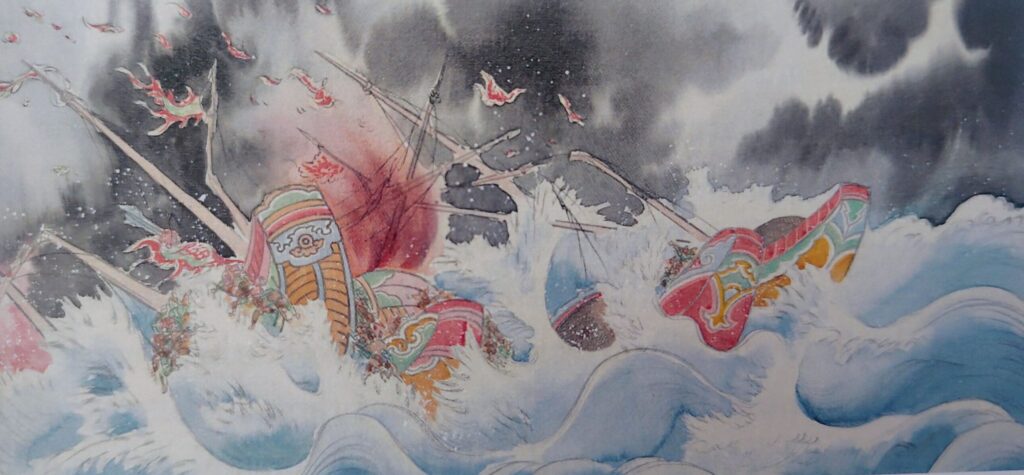
In October of the 11th year of Bunnei (1274), five months after Nichiren Daishonin took up residence in Minobu, just as the Daishonin had predicted, a large army of over 25,000 Mongol warriors invaded Japan. This incident is known as the first Mongolian Invasion (Battle of Bunnei).
The Mongolian army landed on Tsushima Island on October fifth and on Iki Island on the 14th of the same month, and killed unarmed islanders there. Furthermore, on the 20th of the same month, the Mongolian army, gaining momentum, landed in the western area of Hakata Bay and advanced inland. Many commanders and soldiers, including the lord of Tsushima Province, and many local inhabitants died as a result of this invasion.
Nichiren Daishonin stated as follows:
This is solely because of the people’s erroneous views on Buddhism.
(Letter to Soya nyudo [Soya nyudo dono-gosho], Gosho, p. 747)
He declared that the cause of these tragedies was due to the people’s slandering the Law. He advocated that the government and the people of Japan should immediately renounce all the slanders against the Law prevalent throughout the country and take faith in true Buddhism.
Seven years later, in May of the fourth year of Koan (1281), the Mongols attacked Japan again with a vast army, even larger than the one sent during the Battle of Bunnci. This second attack is known as the Battle of Koan. Despite these two battles, the Mongols failed to invade the mainland of Japan. But these events eventually contributed to the weakening and fall of the Kamakura government many years later.
Atsuwara Persecution
In the 11th year of Bunnei (1274) after Nichiren Daishonin had entered Mount Minobu, Nikko Shonin carried out shakubuku activities in the provinces of Kai, Suruga and Izu. The propagation of the Daishonin’s Buddhism dramatically advanced in the areas around Shijuku-in Temple in Kambara and Jissoji Temple in Iwamoto of Fuji County, where Nikko Shonin had received Buddhist training during his childhood.
Moreover, around the first year of Kenji (1275), Shimotsuke-bo Nisshu, Echigo-bo Nichiben, Sho-bo Nichizen61” and others,
ーーーーーーーーーー
61 Shimotsuke-bo Nisshu, Echigo-bo Nichiben, Sho-bo Nichizen: Priests of Ryusenji Temple. They converted to Nichiren Daishonin’s teaching through Nikko Shonin’s propagation efforts. Nisshu was one of the six major disciples of Nikko Shonin and the founder of the Rikyobo. Nichiben was one of Nikko Shonin’s disciples and the founder of the Renjobo. Nichizen was one of the six major disciples of Nikko Shonin and the founder of the Minaminobo. These three temples are among the lodging temples of Head Temple Taisekiji.
ーーーーーーーーーー
who belonged to Ryusenji Temple62, an old temple of the Tendai sect, converted to Nichiren Daishonin’s Buddhism. This wave of shakubuku extended to the people in the neighboring regions. Three brothers, Jinshiro, Yagoro, and Yarokuro, who were trusted by the farmers of Atsuwara Village, also converted to the Daishonin’s Buddhism. Subsequently, the number of new believers who took faith in true Buddhism continued to rise.
Fearing this situation, Gyochi63, the deputy chief priest of Ryusenji Temple, conspired with local government officials, supported by Hei-no sacmon-no-jo, a top-ranking official of the Hojo clan at that time, and established a faction to fight against the Hokkeko believers in Atsuwara Village. Gyochi was looking for an opportunity to destroy them.
On September 21st of the second year of Koan (1279), many Hokkeko believers were helping to harvest the rice crop from Shimotsuke-bo Nisshu’s fields. Hearing this, Gyochi hastily rounded up warriors who forced their way to the fields, where they attacked and wounded the farmers. 20 believers including Jinshiro were arrested there and held in custody at the regional government office in southern Fuji Province. They were accused of illegally harvesting the rice crop from a field owned by Ryusenji Temple.
Furthermore, Gyochi used the name of Yatoji (an older brother of Jinshiro and supposedly an officer of the manor of Ryusenji Temple), whom he had won over, and crafted a false complaint, in order to
ーーーーーーーーーー
62 Ryusenji Temple: A temple of the Tendai sect that was located in Arsuwara Village im Fuji County, Suruga Province (Currently Fuji Ciry, Shizuoka Prefecture). On the premise where Ryusenji Temple of the Tendai sect once stood, the Sixty-sixth High Priest Nittats Shonin established Ryusenji Temple of Nichiren Shoshu.
63 Gyochi [Dates of birth and death unknown]: Hei-no sakon nyudo Gyochi. He wa related to the Hojo clan, and is said to have been an evil priest who thought nothing killing animals
ーーーーーーーーーー
make Jinshiro and others appear to be criminals. Gyochi took further legal steps with the court in Kamakura. As a result, the farmers were transferred to Kamakura the same day.
Upon hearing this news, Nikko Shonin wasted no time to report the situation to the Daishonin in Minobu. Out of deep compassion for the believers in Atsuwara, the Daishonin immediately wrote a letter, which was later referred to as On Persecutions Befalling the Buddha (Shonin gonan ji), so that all his disciples and followers would be united and determined to overcome the adversity. At the same time, the Daishonin drafted the Counterclaim against Ryusenji Temple (Ryusenji moshijo), and Nikko Shonin wrote its final copy, which was presented to the court in Kamakura to explain what truly had happened.
On October 15th, when the Counterclaim against Ryusenji Temple was submitted, Hei-no saemon-no-jo, without clarifying the facts of the matter, interrogated the farmers at his residence. He threatened them by saying, “You must immediately renounce the Daimoku of the Lotus Sutra and, instead, chant the Nembutsu. Otherwise, you’ll be convicted of a felony.”
Jinshiro and the other believers, who were always taught to have firm faith in the Lotus Sutra, did not even wince and single-mindedly continued to chant Daimoku.
Hei-no saemon-no-jo was so infuriated at seeing the farmers chanting Daimoku, that he instructed his 13-year-old son, linuma hogan Sukemune, to torture them with whistling arrows. Despite this, the Hokkeko believers’ faith did not waver at all, but rather, their voices became even louder as they continued to chant Daimoku. Hei-no saemon-no-jo exploded in anger, and finally beheaded three of them, Jinshiro, Yagoro, and Yarokuro, who were the leading figures among the farmers.
In this manner, during the Atsuwara Persecution, these farmers, who were in the weakest position in Japanese society, never gave in, refusing to renounce their faith. In particular, the three believers, who gave their lives for the sake of the Law, were later called “the Three Martyrs of Atsuwara64,” and have been praised as shining examples for the rest of the believers for generations to come.
Hei-no saemon-no-jo, who repeatedly persecuted the Daishonin during his lifetime, received severe karmic retribution for his actions, exactly as described in the Lotus Sutra. In the first year of Einin (1293), 14 years after he beheaded Jinshiro, Yagoro, and Yarokuro, Hei-no saemon-no-jo and his entire clan perished.
Nikko Shonin referred to this event in an inscription on the side of the Gohonzon that he transcribed on April eighth of the third year
ーーーーーーーーーー
64 Right outside of the front gate of the Hoando, stands the monument of the Three Atsuwara Martyrs.
ーーーーーーーーーー
of Tokuji (1308). The inscription states:
beheaded some of the Hokkeko believers (in Atsuwara), he was Fourteen years after (Hei-no) saemon nyudo (Yoritsuna) executed by the government on charges of plotting a rebellion against the Shogunate, and his offspring completely perished65.
(Essentials of the Fuji School [Fuji-shugaku yoshu],vol. 8, p. 217)
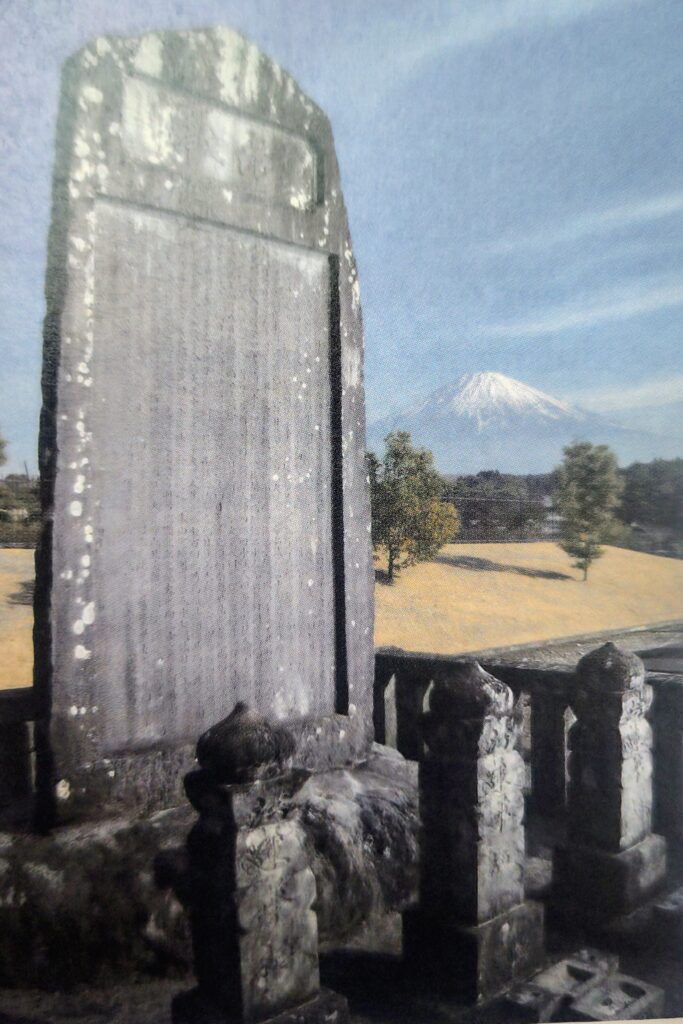 The Monument of the Three Atsuwara Martyrs at Head Temple Taisekiji
ーーーーーーーーーー
65 This incident is known in Japanese history as the Revolt of Hei-no saemon-no-jo Yoritsuna (Taira-no-Yoritsuna)
ーーーーーーーーーー
The Dai-Gohonzon of the High Sanctuary of the Essential Teaching
Despite the fact that the Atsuwara farmers had taken faith in Nichiren Daishonin’s Buddhism only for a short time, they continued to uphold the teaching in the face of such an unprecedented persecution. The Daishonin praised their strong faith and determined that the time had come to reveal the fundamental object of worship of the Buddhism of the sowing, for all mankind to uphold.
The Daishonin referred to the timing of accomplishing the objective of his advent in the following Gosho passage, written on October first:
I first spoke about the doctrine [Nam-Myoho-Renge-Kyo] [at noon on the twenty-eighth day of the fourth month in the fifth year of Kencho (1253)]. Twenty-seven years have passed since then and it is currently the second year of Koan (1279). It took Shakyamuni Buddha forty-odd years, the Great Teacher Tiantai thirty-odd years, and the Great Teacher Dengyo66 twenty-odd years to accomplish the purpose of their advents. The great and severe persecutions that befell them during those years are indescribable. I, Nichiren, already have discussed this matter with you. It has taken me twenty-seven years.
(On Persecutions Befalling the Buddha [Shonin gonan ji], Gosho, p. 1396)
ーーーーーーーーーー
66 The Great Teacher Dengyo [762-822]: The founder of the Tendai sect in Japan,also called Saicho. He refuted Hinayana and provisional Mahayana Buddhism, which were prevalent in Japan, and dedicated himself to the propagation of the Lotus Sutra. He established in Japan the first high sanctuary of Mahayana Buddhism based on the theoretical teaching of the Lotus Sutra.
ーーーーーーーーーー
In the midst of the Atsuwara Persecution, on October 12th of the second year of Koan (1279), the Daishonin inscribed the Dai-Gohonzon of the High Sanctuary of the Essential Teaching, accomplishing the ultimate purpose of his advent.
Considering the perpetuation of true Buddhism for eternity in the Latter Day of the Law, the Daishonin inscribed the Dai-Gohonzon on a thick wooden plank from a camphor tree. He then instructed his disciple. Nippo, to carve out the characters of the Dai-Gohonzon.
The Twenty-sixth High Priest Nichikan Shonin67 expounded that the Dai-Gohonzon is the ultimate purpose of the Daishonin’s advent.
He stated:
The Gohonzon of the High Sanctuary of the Essential Teaching, inscribed in the second year of Koan (1279), is the supreme entity of the Law of Nichiren Daishonin’s entire life. and is the ultimate and conclusive purpose of his advent. It is the core of the Three Great Secret Laws, since it is, in fact, entire world. the original object of worship to save all living beings in the entire world.
(Exegesis on the True Object of Worship [Kanjin no honzon-sho mondan), Mondan, p. 197)
ーーーーーーーーーー
67 Nichikan Shonin [1665-1726]: The Twenty-sixth High Priest of Head Temple Taisekiji. He was born in Maebashi, Kozuke Province (Currently known as Maebashi City, Gumma Prefecture). Before entering the priesthood, his secular name was Ito Ichinoshin. At the age of 19 in 1683, he heard a sermon given by the Seventeenth High Priest Nissei Shonin in Jozaiji Temple and decided to become a priest. He later, in fact, became a disciple of the Twenty-fourth High Priest Nichiei Shonin, and was given the priestly name, Kakushin Nichinyo. At the age of 44, he was promoted to the chief instructor of the Hosokusa Danrin Institute and his priestly name was changed to Kenju-in Nichikan. In March of 1718, he received the Heritage of the Law from the Twenty-fifth High Priest Nichiyu Shonin and became the Twenty-sixth High Priest of Head Temple Taisekiji. He organized Nichiren Shoshu doctrines by authoring the Six-Volume Writings (Rokkan-sho), the annotations of Nichiren Daishonin’s Gosho and many more writings, thus promoting the truth and upholding the orthodoxy of Nichiren Daishonin’s teachings. Furthermore, he devoted himself to the prosperity of Nichiren Shoshu by establishing the Ever-chanting Temple (Joshodo). In addition, as one of the promoters he left the funds for building the Five-storied Pagoda (Goju-no-to). Due to his great achievements, Nichikan Shonin is revered as a Restorer of Nichiren Shoshu together with the Ninth High Priest Nichiu Shonin. He passed away at the age of 62 on August 19th in 1726.
ーーーーーーーーーー