On the Significance of Pilgrimage to the Head Temple
This is an edited version of a translation of a document prepared by the Current Affairs Conference, Resources Group 1 of the Nichiren Shoshu Priesthood, and published in the August 1, 1991 issue of Dai-Nichiren.
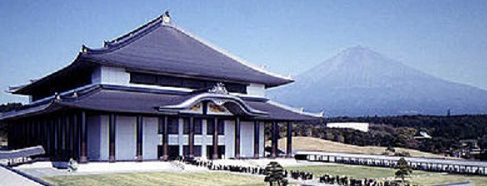
The Dai-Gohonzon of the High Sanctuary1, the source for all humanity to attain enlightenment and the purpose for the advent of Nichiren Daishonin, the founder of this sect, is at Taisekiji, the Head Temple of Nichiren Shoshu. Thus, Taisekiji is the most sacred precinct in the entire world. We customarily refer to pilgrimage to the Head Temple Taisekiji as Tozan2, and use this as an occasion to pray for our own enlightenment, for the happiness of our families, for the welfare of society and the world, and for the attainment of the True Buddha Nichiren Dais-honin’s Great Aspiration of Kosen-rufu3.
The Head Temple is the Fundamental Sacred Precinct of Faith
The Three Great Secret Laws4 the Object of Worship of True Buddhism, the Invocation of True Buddhism and the High Sanctuary of True Buddhism the foundation of the Buddhism of Nichiren Daishonin. Attainment of both our personal happiness and world peace lies in wholly accepting and continuing faith and practice in the Three Great Secret Laws.
The source of all the Three Great Secret Laws is the Object of Worship of True Buddhism, the Dai-Gohonzon of the High Sanctuary of True Buddhism, inscribed on 12 October 1279, and enshrined at the Head Temple in the Shohondo. To have an audience with and worship the Dai-Gohonzon with the permission of the High Priest is what it means to truly accept and receive the Three Great Secret Laws, and is the greatest happiness for us as humans born in this life and the source of great benefit on into the future. Furthermore, the Dai-Gohonzon is the life of Nichiren Daishonin, as the Daishonin explains in the Reply to Kyo’o, “I, Nichiren, have inscribed my life in sumi”5 (MWJN, vol. I, p.120). Therefore, when we go on Tozan to the Head Temple, Taisekiji and attend the Gokaihi Ceremony, we are meeting with Nichiren Daishonin.
In the Person and the Law,Nichiren Daishonin teaches that, “…deep in this mortal flesh I preserve the In The Person and the Law, Nichiren Daishonin ultimate secret Law inherited from Shakyamuni Buddha at Eagle Peak 6 My heart is where all Buddhas enter nirvana7: my tongue, where they turn the wheel of doctrine; my throat, where they are born into this world. and my mouth, where they attain enlightenment. Because this mountain is where the wondrous votary of the Lotus Sutra dwells, how can it be any less sacred than the pure land of Eagle Peak? Since the Law is supreme, the person is worthy of respect; since the person is worthy of respect, the land is sacred… Those who visit this place can instantly expiate the sins they have committed since the infinite past and transform their illusions into wisdom, their errors into truth, and their sufferings into freedom.”
(MWN vol. 1, p. 264)
Furthermore, in the Oko Kikigaki, He teaches: “The eternal realm of Eagle Peak is this Saha8 world, which especially signifies Japan. The True Land of the Lotus Sutra is this Saha world, which is the land for the estab lishment of the supreme mandala of the Juryo chapter that has never before existed.”
(Showa Shintei Gosho vol. 3, p.2881)
That is, Taho Fuji Dai-Nichirengezan Taisekiji 9 is in actuality the pure land of Eagle Peak where the True Buddha Nichiren Daishonin dwells and is the true home for our life itself. There is a Gosho which states: “Birds who approach Eagle Peak will turn to gold.” In the same way, if we go on pilgrimage to the Head Temple Taisekiji, participate in the Gokaihi Ceremony 10 before the Dai-Gohonzon of the High Sanctuary through the permission of the High Priest, and pray from the bottom of our hearts to eradicate our many past and present slanders against the Law, and to continually purify and deepen our faith and practice, so that we may attain enlightenment in this and all future existences, according to the words of twenty-Sixth High Priest Nichikan Shonin in the Kanjin no Honzon Sho Mondan. “This Gohonzon bestows limitless, infinite benefit, and Its unfathomable workings are vastly profound. Therefore, if you chant Nam-Myoho-Renge-Kyo with faith in this Gohonzon for even a short while, there is no prayer that will not be answered, no evil that will not be eradicated, no blessing that will not be bestowed and no reason that will not become clear.”
(Fuji Shugagku Yoshu, vol. 4, p. 213)
This means that we will all be able to expiate the limitless karma that we have accumulated from our past lives up until the present, and fulfill both our own personal desires for the present and the future and the Great Aspiration of Kosen-rufu.
Learning from the History of Taisekiji
During the lifetime of Nichiren Daishonin, Abutsubo (who lived on Sado Island), visited Nichiren Daishonin at His residence on Mt. Minobu11 several times, without paying any attention to the demands of his 90-year old body. Nichimya Shonin, a woman, endured the ex treme dangers of travel of those times, and with an attitude of great reverence sought an audience with the Daishonin on Sado Island. 12
Unlike today, in those days there were no transportation systems, and so to go on Tozan meant to cross mountains and rivers on foot, step by step. No matter what the dis tance or the age, the fundamental spirit of going on Tozan to the Head Temple Taisekiji means to have the attitude in faith and practice of these people, the spirit of “single mindedly yearning to see the Buddha, they do not begrudge their lives.”
Of course, the Tozan spirit of people like Abutsubo and Nichimyo Shonin has had a great influence on believers in later ages. The 1855 Tozan travel diary of Abe Jukichi, a believer from Kannonji Temple in Morioka, was included in the Sho Kiroku compiled and edited a few years ago by Reverend Jundo Nose, chief priest of the Kangyobo at the Head Temple. The diary says, “I made my way to the Daibo 13 and weeded the area around the Gohozo. 14 After that I weeded the inner garden and cleaned up in the front of the Kyakuden. “15
(Sho Kiroku, vol. 5, p. 252)
People in those times could not easily go on Tozan several times a year. For this reason, once they went on Tozan, they would stay for several days or several weeks. Also, just as in the case of Abe Jukichi, these pilgrims would also volunteer to do work in service of the Head Temple, such as cleaning.
In the Tokugawa Period (1603-1868), there was in reality no freedom of religion in Japan. The Danka System 16 had been introduced, under which religious debate and the building of new temples were strictly prohibited. Moreover, because of the prejudices of the government administrators, Nichiren Shoshu was trea-ed as a banned religion and was subjected to additional repressive measures.
Even under these difficult conditions, the Kanazawa believers of the Maeda Clan in Kaga Prefecture (present day Ishikawa Prefecture) studied and propagated Nichiren Daishonin’s Buddhism, burning with a passionate seeking spirit. However, since it had been impossible to build a local branch temple, they could not receive a travel pass (which was absolutely necessary under Japanese law at the time) to go to Taisekiji, and their prospects for going on Tozan to the Head Temple were very unpromising. Even so, reports remain of a group of people with the will to make a pilgrimage who banded together, and determined to go on Tozan in violation of all these restrictions. Aiming for the Head Temple, they crossed the numerous mountains and rivers along the way, drinking dew to quench their thirst and using dry wood for pillows and burying themselves under leaves at night. When they reached the Sanmon Gate of the Head Temple, they threw themselves into each others’ arms, crying and rejoicing that they had finally arrived.
There is also a report of believers who found a way to visit the Head Temple during a Sankin Kotai 17 journey of the Maeda Clan. While staying overnight at the Yoshiwara post town on the Tokaido Road, they waited until everyone was fast asleep, sneaked out of the inn under cover of darkness, ran to Taisekiji and chanted Daimoku in front of the Gohozo until early morning. They then returned to Yoshiwara before their fellow travelers woke up. They called this a “Tozan by Stealth.”
Another example is that of Kakurin Nichinyo, a priest who was exiled to Aji Island during the Sendai Persecution 18 in northern Japan. In a letter to the Sendai believers, he taught them the following: “Regardless of youth or age, year by year you should enable as many people as possible who have not gone on Tozan to find ways to fulfill their desire to make the pilgrimage to the Head Temple. The benefit of people who do this is much greater than that of the people who go on Tozan.”
(Fuji Shugaku Yoshu, vol. 9, pg. 334)
“As for aiding others to make a Tozan pilgrimage to the Head Temple which takes many days of travel, since such a Tozan requires financial expenditure – if you have the money to come and visit this island, use it instead to help make a Tozan pilgrimage. Anyone who wishes to make a Tozan pilgrimage need not make the crossing to this island. You should just communicate in writing.”
(Fuji Shugaku Yoshu, vol. 9, p. 335)
Regarding the meaning of this letter, fifty-ninth High Priest Nichiko Shonin praised the Tozan guidance of Kakurin Nichinyo as follows: “His instructions that the benefit of encouraging and enabling people to go on Tozan who have never gone before exceeds the benefit of people who do go on Tozan, and his ‘use the money you could bring me on this island for Tozan expenses’ show a truly respectworthy will.”
(Fuji Shugaku Yoshu, vol. 9, p. 339)
Then there is the story of the Letter Acknowledging the Receipt of a Sho of Rice 19 told by believers at Myokoji Temple in Tokyo. This is the story of a woman who crossed the Hakone barrier, known to be a very perilous pass, on New Year’s eve, carrying her child on her back to take rice to the Head Temple as a New Year’s offering. In response to her sincere faith, the fifty-second High Priest Nichiden Shonin wrote this admirable woman a Letter Acknowledging the Receipt of a Sho of Rice.
There are many such episodes in the seven hundred year history of Nichiren Shoshu. We who are alive in the modern age should never forget that it is because of the strenuously accumulated efforts in the practice of Tozan and the seeking minds of these predecessors that Tocan pilgrimage continues today.
The Significance of Tozan as Taught by the Soka Gakkai and the SGI
The original spirit of the group Tozans conducted by the Soka Gakkai and the SGI conducted until recently was the spirit to be successors to the actions of these people in past ages.
Thus, guidance in the Soka Gakkai/SGI regarding Tozan to the Head Temple was: “Our spirit when we go on Tozan should be as if we had the spirit Abutsubo had when the Daishonin was alive. Abutsubo crossed the stormy ocean from Sado Island, and journeyed across fields and over mountains three times to visit the Daishonin on Mt. Minobu, to serve the Daishonin with all his heart. However remote the age, our Gakkai spirit must be this spirit of Abutsubo.”
(Opening Article of Daiby-aku Renge, October 1963)
“When we go on Tozan and worship the Dai-Go-honzon, this is in itself having an audience with the Dais honin, and it goes without saying that we can enjoy great benefit from this. If there is a group Tozan to go to see the Dai-Gohonzon of absolute benefit, that is, a Gakkai group Tozan, this is the greatest event among all events and must be given priority over all other activities.” (ibid.)
Judging from the contents of this guidance, the group Tozans to the Head Temple conducted by the Soka Gakkai/SGI have traditionally been viewed as having truly great significance. The benefit accumulated by all believers as a result of this is limitless.
It is recognized by all that the Soka Gakkai/SGI has developed along with these group Tozans to the Head Temple. Because of criticism in society by people who called the Soka Gakkai/SGI a “New Religion,” new members often felt uncertain even after taking faith as a result of shakubuku. But when they stood in front of the Sanmon Gate at Taisekiji, they gained the great confidence that, “This is not a ‘New Religion’ it is a religion with a correct lineage of seven hundred years.” Isn’t chia something that all members of the Soka Gakkai/SGI have felt for themselves?
There have also been innumerable examples of mem bers who, when receiving permission to attend the Go kaihi Ceremony, found that at the time of their audience with the Dai-Gohonzon, their tears would not stop flowing and at that moment they felt a conviction well up from with that this religion is absolute.
Furthermore, Honorary President Daisaku Ikeda said the following at the First Group Tozan Leadership Meet-ing on the 30th of September, 1970: “Next, I would like to speak about the significance of group Tozan. For us, it goes without saying that the fundamental object of worship of our faith is the Dai-Gohonzon of the High Sanctuary. Having an audience with this Dai-Gohonzon is the most important purpose of Group Tozan, and is itself the significance of Tozan.”
(The Complete Writings of Pres. Ikeda, vol. 4, Lectures, p. 210)
After this straightforward introduction, he further explained the significance of Tozan as follows: “First, we pray to eradicate our past and present slanders against the Law, and for peace and security in this life and good circumstances in the next… Second, it means to return to the home of our lives of Kwon Ganjo and to receive the clean, pure, fresh life force that is at the wellspring of our lives… Third, we must construct a true organization based on the realization that we are all equally Nichiren Daishonin’s disciples and are Bodhisattvas of the Earth Fourth, is to make a pledge to the Dai-Gohonzon with the determination to fight for Kosen-rufu in the age of Mappo Fifth, is to pray for the happiness and peace of all humanity, and to vow to progress towards that ideal.” (ibid.)
In an even more direct manner, Second President Josei Toda stated, “When all is said and done, if you don’t go on Tozan yourself and pray to the Dai-Gohon-zon, your faith will not mature.” (The Collected Lectares of Josei Toda, vol. I, p. 112)
Thus, pilgrimage to the Head Temple Taisekiji is of truly deep importance to our faith and practice as Nichiren Shoshu believers.f