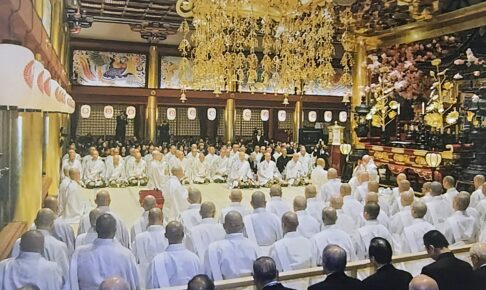
When visiting your local Nichiren Shoshu Temple you will probably notice that in the sanctuary, next to the main altar there is a second, smaller altar usually on the right hand side. It has the offerings of a candlestick, incense burner, evergreens, and water. Above these offerings are slots or spaces to place memorial tablets. At the front is a large powdered incense burner. The purpose of this Memorial Altar is for the offering of Toba Memorial Tablets for the benefit of the deceased. This is a very significant aspect of the practice of Nichiren Shoshu Buddhism.
The word Toba is Japanese for the word Stupa in Sanskrit. The original form of a Stupa in ancient India was that of a burial mound. Many different forms of stupas developed over the years in both India and China. The five-story pagoda is one of the most commonly known forms of a stupa.
In Nichiren Shoshu, the Toba memorial tablet also takes the form of five levels. The five levels signify the five elements of earth, water, fire, wind, and ku (non-substantiality). The bottom level of the Toba is shaped like a square. This represents earth. The second level is in the shape of a circle, representing water. The third level, denoting fire, is a triangle. The fourth level, in the shape of a semicircle, represents wind. At the top of the Toba is the level representing ku. It is shaped like a jewel signifying the “treasure of fulfillment.” The Daishonin taught that all phenomena in the universe are composed of these five elements. This, of course, includes the human body. Therefore, the Toba signifies the body of the deceased.
These five levels of the Toba, and the five elements, also correspond to the five characters of Myo-Ho-Ren-Ge-Kyo. The Daishonin teaches in the “Record of Orally Transmitted Teachings” (Ongi Kuden):
The head represents Myo, the throat is Ho, the chest is Ren, the womb is Ge, and the legs are Kyo. This five-foot body of ours is, indeed, the manifestation of the five characters of the Mystic Law, Myoho-Renge-Kyo.
(Gosho, p.1728)
The Daishonin also states in the Gosho, “On the Ultimate Teaching Affirmed by All Buddhas:”
The five elements are earth, water, fire, wind, and ku …. These are, in other words, the five characters of Myoho-Renge-Kyo.
(Gosho, pp. 1418-1419)
From this it is clear that the five levels of the Toba also signify the body of the Buddha.
It is an extremely important part of our practice to offer prayers to the Gohonzon for the enlightenment of the deceased. We offer such prayers to the Gohonzon during the final silent prayer during Morning and Evening Gongyo every day. Moreover, Nichiren Shoshu Temples conduct special ceremonies specifically for the purpose of offering prayers for the enlightenment of the deceased. These include the annual Urabon Ceremony, the semi-annual Higan-e Ceremony, and the regularly scheduled Monthly Memorial Ceremonies.
When we chant sincere Daimoku to the Gohonzon for the enlightenment of the deceased, we, ourselves can attain enlightenment. In addition, the deceased, who cannot chant Daimoku for themselves, gain tremendous benefit from the Daimoku we chant for them. This is the principle behind the Toba Memorial Service. The True Buddha, Nichiren Daishonin stated:
The deceased rely on the benefits of offerings from their relatives. So you should offer your benefit to them to relieve their suffering.
(Shintei Gosho, Vol. 1, p. 72)
Down the center of the Toba is inscribed Myoho-Renge-Kyo. There is also an inscription in Chinese characters stating, “Here exists the body of the Buddha.” Under the Daimoku is the name of the deceased. On the reverse side of the Toba is inscribed the name of the person who requested it for the benefit of the deceased.
The Toba is requested by a believer and is inscribed by a Nichiren Shoshu priest. The ceremony to offer the Toba is performed at the Temple by the priest. The Toba can be requested for a deceased individual person, a deceased pet animal, or for a family, such as “The Smith Family.” This would indicate the deceased ancestors of Mr. or Ms. “Smith.”
Contents
HOW TO REQUEST A TOBA MEMORIAL TABLET
In order to request a Toba, one must be a Nichiren Shoshu believer. Abeliever may request a Toba at any time, and as often as he or she wishes. If the request for a Toba is made on a day when there is no ceremony, the chief priest, depending on his schedule, may conduct a special ceremony for the offering of the Toba, or he may offer the Toba to the Gohonzon and pray for the enlightenment of the deceased person during the regularly scheduled Gongyo at the Temple.
Requests for a Toba are made in writing at your local Nichiren Shoshu Temple, or the Temple you are visiting. If you wish to offer a Toba at the Head Temple while you are making a pilgrimage (tozan), you may make your request in the Toba shitsu (the Toba office next to the Mutsubo) on the Head Temple grounds. If you don’t live near a Nichiren Shoshu Temple, you can make your request by mail.
The Temple will give you a Toba Request Form. It asks for the date you want the Toba to be offered, the name of the deceased, and the name of the person making the request. If possible, the relationship of the deceased to the person making the request (such as father, aunt, friend, pet dog) and the age of the deceased should be written on the application. Gokuyo should accompany the application.
It is most advantageous if the believer making the request can be present at the Temple when the Toba is being offered to the Gohonzon. This way, the Priest and the believer can pray in unity for the enlightenment of the deceased. If this is not possible, the Priest will offer the Toba in your absence.
Requesting a Toba Memorial Tablet at Special Ceremonies
The Urabon, Higan-e, and Group Memorial Ceremonies at the Temple are conducted for the specific purpose of offering prayers to the Gohonzon for the enlightenment of the deceased. At these ceremonies, Toba Memorial Tablets are offered by many people. Because of the large number of Toba Tablets that have to be inscribed by the priest, applications for requesting a Toba are usually available several weeks to a month before the ceremony takes place. When an offering of a Toba is made on a non-ceremony day, the Toba you requested with the name of the deceased will usually be visible when you approach the Memorial Altar. However, during the large ceremonies when many believers offer Tobas, they will be stacked one behind the other because of limited space. In this case, most of the Tobas will not be visible.
Requesting a Toba Memorial Tablet for Individual Memorial Ceremonies.
An Individual Memorial Ceremony is conducted for the deceased on a specific anniversary date according to the teachings of True Buddhism. A Toba is traditionally requested for a deceased loved one every seventh day for the first forty-nine days after death. Another Toba is offered on the one hundredth day after death. There are also yearly anniversaries where Toba Tablets are traditionally offered to the Gohonzon. If you are attending a Memorial Ceremony as a guest in support of a fellow believer, you can also request a Toba for the deceased person. If many believers attend an Individual Memorial Ceremony, there may be many Tobas offered at the same time by various people for that deceased person.
OFFERING POWDERED INCENSE AT THE MEMORIAL ALTAR
When a Toba is offered to the Gohonzon, the priest prepares the Memorial Altar for the ceremony. The candle and an incense char coal are lit and placed in the powdered incense burner at the front of the altar. An open container of incense powder is placed next to the burner.
 The recitation of the Sutra begins. When the chief priest begins the recitation of the Chogyo section of the Juryo chapter of Gongyo (Part B of the sutra book), the assistant Priest goes to the Memorial Altar, takes the powdered incense burner, and places it on the table in front of the Chief Priest. The Chief Priest then offers powdered incense in the burner. The assistant Priest then places the burner back on the Memorial Altar, offers powdered incense himself, faces the believers, and bows. At this time, all those offering powdered incense should approach the Memorial Altar in an orderly fashion.
If there is only one priest in attendance, he usually offers the powdered incense before he takes his seat at the main altar to start the recitation of the Sutra. In this case, when he begins reciting the Chogyo section of the Juryo chapter of Gongyo (Part B), the believers may approach the Memorial Altar to offer powdered incense. It is not correct to wait until the sutra recitation is finished and offer powdered incense during the chanting of Daimoku. If, however, there are so many people offering powdered incense that it is not possible to finish before Daimoku starts, an exception is made.
When approaching the Memorial Altar, one should chant silently. With palms together, face the Gohonzon, offer three Daimoku silently, and bow. Then face the Memorial Altar, offer three Daimoku silently, and bow. Take a small pinch of incense powder between two fingers, gently raise the hand holding the incense slightly above eye level as a gesture of respect, and place the incense powder on the charcoal in the burner. This is done three times. Then, with palms together, face the Memorial Altar, offer three Daimoku silently, and bow. Then, face the Gohonzon, offer three Daimoku silently, and bow, and return to your seat. When you are seated you may resume the sutra recitation aloud.
There is tremendous benefit in offering a Toba Memorial Tablet. Through the power of the Mystic Law we are able to reach and affect the life of the deceased. The Daishonin states:
You erected a sixteen-foot sotoba with the seven characters of Nam-Myoho-Renge-Kyo inscribed on it….Your deceased parents must be illuminating the pure land as brilliantly as would the sun and moon in the heavens. Furthermore, you yourselves, their filial son and his wife, as well as your children, will live to be one hundred and twenty.
(MW, Vol. 5, p. 299, Gosho, p. 1434)