An individual cannot practice correctly or nurture strong faith alone. Sometimes believers would rather practice faith by themselves. However, even in the case of worldly pursuits, it is not possible to do everything alone. If we want to study, we go to school. If we want to earn a living, we must go to our workplaces and interact with others. We learn various skills from our superiors, seniors, or teachers. By cooperating with classmates or colleagues, we make progress in our education or in our work.
In the same way, in the practice of Nichiren Shoshu, we can make progress and deepen our faith when we attend a variety of events. We can receive encouragement from our seniors in faith and likewise encourage fellow members. Nichiren Daishonin stated:
Those resolved to seek the Way should all gather and listen to the contents of this letter. (“Letter from Teradomari,” MW, Vol. 4, p. 97, Gosho, p. 484)
He also stated: The long journey reveals the depth of one’s faith.
(Gosho, p. 689).
If we want to become happy through faith, we should gather together with others and study Buddhism. Then, as now, the desire to participate with other Buddhist believers is an integral part of Buddhist practice. The variety of events available to us fall into two general categories:
1. Nichiren Shoshu services and ceremonies held at the Head Temple and at local Temples, and 2. Hokkeko meetings to promote faith, practice, and study for individual members.
Contents
SERVICES AND CEREMONIES IN NICHIREN SHOSHU
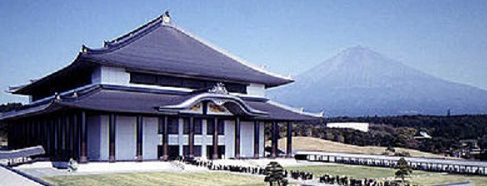
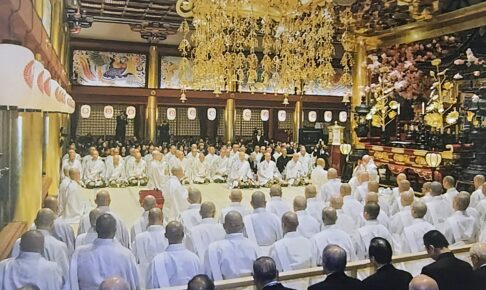
Services and ceremonies conducted at the Head Temple and at local Temples express and reveal various profound aspects and concepts of Nichiren Daishonin’s Buddhism.
It is impossible for us, ordinary mortals swayed by emotion, to understand the profound principles of the Daishonin’s Buddhism fully. Even if we are able to understand some of them, to believe in and to retain them firmly and correctly is extremely difficult.
For this reason the Head Temple and each local Temple conduct traditional services and ceremonies in order to reveal the profound doctrines of the Daishonin’s Buddhism. By participating, even without our conscious awareness, we are deeply absorbing their influences. This will be the foundation for us to be able to continue to practice with correct faith based on the profound Buddhist doctrine handed down for more than 750 years.
If we separate ourselves from this source, we will not gain truly great benefit no matter how much we exert ourselves i n Gongyo, shakubuku, or study. Eventually, solitary faith will be transformed by our egocentric ideas into a belief of an entirely different nature from the Daishonin’s correct Buddhism.
From time to time, some members may express disinterest in attending ceremonies and activities. However, it is important to keep in mind the fundamental significance of the services and the deep meaning of the ceremonies conducted in Nichiren Shoshu.
The profound doctrines of the Daishonin’s Buddhism will always be revealed in the form of services and ceremonies. For a believer, correct faith involves enthusiastic and consistent attendance and appreciation of this on-going process. These are the major ceremonies and services of the Nichiren Shoshu calendar:5
Annual Ceremonies:
Gantan Gongyo, (New Year’s Gongyo), January 1st
Koshi-e Ceremony, (Memorial for Second High Priest, Nikko Shonin), February 7th
Shuso-Otanjo-e Ceremony, (Nichiren Daishonin’s Birthday), February 16th
Spring Higan-e, (Spring Memorial Ceremony at the Equinox), around March 21st
Risshu-e Ceremony, (Celebrating the declaration of True Buddhism), April 28th
Daigyo-e Ceremony, (Memorial ceremony for Nanjo Tokimitsu), May 1st
Urabon Ceremony, (Special Annual Memorial Service for the deceased), July 15th
Kanshi-e Ceremony, (Memorial ceremony for Twenty-sixth High Priest, Nichikan Shonin), August 19th
Tatsunokuchi Gonan-e Ceremony, (Commemorating the Tatsunokuchi Persecution), September 12th
Fall Higan-e, (Fall Memorial Ceremony at the Equinox), around September 22nd
Ushi-e Ceremony, (Memorial ceremony for Ninth High Priest, Nichiu Shonin) September 29th Mokushi-e Ceremony, (Memorial for Third High Priest, Nichimoku Shonin) November 15th
Oko6 Ceremony, (Ceremony to repay our debt of gratitude to Nichiren Daishonin, Nikko Shonin, and Nichimoku Shonin), Every 7th, 13th, and 15th of the month at the Head Temple; usually once a month on or around the 13th at local temples.
Special Ceremonies:
Ushitora Gongyo, every morning at the Head Temple Goreiho Omushibarai-e, (Airing of the Sacred Treasures Ceremony), April 7th at the Head Temple Shuso Gotai-e (Oeshiki), (Celebration of Nichiren Daishonin’s passing), November 21st by the modern calendar, at the Head Temple; October 13th, by the lunar calendar, at most local Temples
Of all the services and ceremonies held at the temples, the most important ceremony for us to attend is the monthly Oko.
The Oko ceremony is held in reverence to the Buddha, the Law, and the Priesthood of the Three Great Secret Laws, and to repay our gratitude to them. This denotes the True Buddha, Nichiren Daishonin; the True Object of Worship, the Dai-Gohonzon; Nikko Shonin, Nichimoku Shonin, and the successive High Priests. It is held on the 13th day of every month, the day of Nichiren Daishonin’s passing, at the Head Temple, and on a date near the 13th in all Nichiren Shoshu local Temples.
It is very difficult for us to attend the services and ceremonies held at the Head Temple, because of the great distance, so we make every effort to attend the monthly Oko ceremony held at our local Temple, and repay our gratitude to the Three Treasures from the bottom of our hearts.
HOKKEKO MEETINGS
At Hokkeko meetings members gather together to do Gongyo, chant Daimoku, share experiences, ask questions, and study in order to learn about the great power of the Gohonzon. These meetings are generally conducted in an informal environment such as a member’s home. Occasionally a priest may also attend and lecture, answer questions, and provide guidance in a smaller, more relaxed atmosphere.
It is important to attend as many such meetings as possible because when we do, conviction in the absolute power of the Gohonzon, the way to practice correct faith, and deeper knowledge gained through study will naturally take root in our lives. The experiences of other members, the friendships based on faith, a shared desire for Kosen-rufu, and our joint efforts in shakubuku all serve to help us deepen our faith and consequently advance in our lives. These Buddhist activities also help encourage us to overcome obstacles as they arise in the course of our practice. T
he essential thing is that, through holding these various meetings repeatedly and discussing the questions and experiences from numerous points of view, members will develop faith free of egotistical or biased viewpoints, in a pleasant atmosphere.
0.