
The reason we joined Nichiren Shoshu was to establish unshakable happiness in our lives. However, as Nichiren Daishonin stated, “To accept is easy; to continue is difficult.”
(MW, Vol. 1, p. 127, Gosho, p. 775)
It is nearly impossible for us to continue faith throughout life when we know little about the doctrines of True Buddhism.
It is essential for us to study the teachings of Nichiren Daishonin’s Buddhism, enabling us to understand the reasons to continue practicing. We can resolve doubts, overcome laziness, and strengthen our practice through study, so that when we face obstacles and want to stop, we will be able to bolster our faith.
Also, we will steadily learn correct faith without dogmatism or an egotistical point of view and gain the knowledge necessary for shakubuku and propagation of the True Teachings. We can gradually deepen our conviction in True Buddhism and carry out faith throughout our life. Therefore, study is a necessary support and supplement to faith.
Faith without study results in a shallow, blind faith, an incorrect attitude, and the failure to continue practicing when one is met by some difficulty. Nichiren Daishonin stated:
Exert yourself in the two ways of practice and study. Without practice and study, there can be no Buddhism.
(MW, Vol. 1, p. 95, Gosho, p.668).
READING THE GOSHO
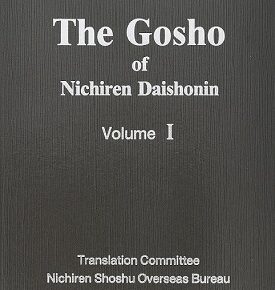
Study 55 Study means learning the doctrines of Nichiren Shoshu. Teachings of other sects do not have the transmission of the True Law and do not convey the Daishonin’s true intention. The basis for the study of Nichiren Shoshu is Nichiren Daishonin’s Gosho.
The Gosho, the writings of the Daishonin, reveal the truth of the Daishonin’s Buddhism, the superiority and inferiority or the shallowness and depth of all religions, and the correct attitude in faith. By using the Gosho as the source, we are able to directly study the teachings of the Daishonin.
While reading the Gosho, it is important to remember that profound meanings are hidden in them. There are great distinctions between the contents of the Daishonin’s teaching before and after the Sado Exile. In His teachings before Sado, for example, there is not the slightest mention of the Three Great Secret Laws. Learning important background information such as this will further help us in our study of True Buddhism.
There are many points of profound significance underlying the Daishonin’s Gosho. Each Gosho may reveal different depths of the teaching that is being imparted according to the relative strength of each recipient’s faith. For example, the Twenty-sixth High Priest, Nichikan Shonin, taught that although there is only one name for Shakyamuni, there is actually a distinction among six “kinds” of Shakyamuni in the Daishonin’s Gosho. Thus, we study the Gosho based on the interpretations and explanations of the successive High Priests in order to learn the true meanings of the passages.
The importance of this point can be shown through the famous parable in which two blind men touched the body of an elephant for the first time. The one who grabbed the elephant’s nose had thought that it was a tube-like animal, whereas the one who touched its belly believed it to be like a wall.
The Daishonin stated, “It is impossible to understand the intention of the Lotus Sutra without the face-to-face transmission of this Buddhism” (Gosho, p. 92). Only through the explanations given by the successive High Priests, who have handed down the heart of the Daishonin’s profound and deep Buddhism, can we understand the true intention of the Daishonin as shown in the Gosho. We must embrace this lineage deeply in our hearts and study correctly, basing our reading of the Gosho on faith in the Master and Disciple relationship.
ATTITUDE IN STUDY
Given our busy daily lives, we would be unlikely to pursue our Buddhist studies without an enthusiastic and determined attitude. We can make use of every available opportunity to open the Gosho and read it.

Understanding deepens when a person studies based on faith. This makes Buddhist study different from any other learning. A person who studies Buddhism without faith cannot easily grasp the great depth of the Buddha’s teachings. However, the faith mentioned here has nothing in common with blind or fanatic faith where one is expected to never have doubts. It is extremely important to thoroughly inquire about any of our doubts. In this way, we follow the teachings that are reasonable, have supporting proof, and overcome our doubts at the same time. Such an attitude is the meaning of “correct faith.
” This teaching is based on the idea that “Buddhism is reason” (MW, Vol. 3, p. 238; Gosho, p. 1179) and it regards actual proof very highly. As the Gosho states: “Nothing is more certain than actual proof” (MW, Vol. 4, p. 121; Gosho, p. 1106). If we study with faith, we can clear away any doubts and be able to master the profound teachings. We study with enthusiasm and with the spirit of yearning to grasp the truth, with constant questions like “Why?” or “How can I understand this?”
Finally, in our study of the Gosho, we do not concentrate only on the theoretical meanings of various Buddhist concepts. Underlying these concepts is the great, powerful conviction of the founder, the Daishonin. The truth of Buddhism is unfathomable by the wisdom of a common mortal. If we ignore these aspects, we are merely engaging in an intellectual exercise. Correct study is the compass and backbone of our faith.