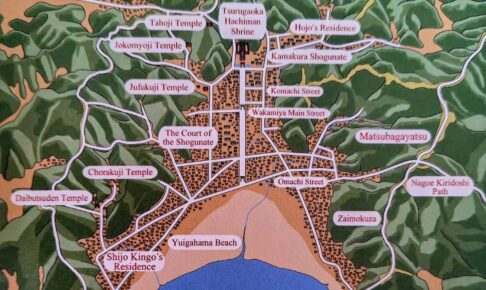
Before we encountered True Buddhism, we may never have considered the importance of choosing the correct religion, and we probably had never believed that this choice would have a crucial influence on our happiness or unhappiness in life. Fortunately, however, through Nichiren Daishonin’s great teachings we are learning about truth and falsehood in religion, and realize that the root cause of all unhappiness in the world lies in provisional religions. For example, when you lose your way, you can find out where you are by consulting an accurate map. Likewise, you can only determine the truth or falsehood of all religious teachings through the one True Teaching. As explained earlier, faith is the mystic principle of a mutual interaction between living beings (the believers) and the enlightened life of the Buddha (the object of worship), and so it forms the basis of the believer’s life. We must therefore distinguish between superior and inferior, true and false, and shallow and deep teachings in order to avoid following a futile path.
People often maintain that since the objectives of all religions are the same, it does not matter which one you believe in, since “however you choose to climb Mt. Fuji, you will still reach the same summit.” However, even if you begin with the intention of ascending to the summit, if you use an inaccurate map and set off from the wrong point or use the wrong climbing techniques, then far from reaching the summit, you will surely meet with disaster. In addition, all the people who trust you as their guide and follow you will meet with disaster in the same way. Similarly, no matter how much you intend to exert yourself in your faith to become happy, if you believe in a provisional religion, or continue blindly believing the words of a religious teacher who expounds mistaken teachings, you will certainly reach a dead-end in your life and become immersed in confusion and suffering.
0Although all religions claim that their own teachings are the highest, it is impossible for there to be so many “supreme teachings.” Shakyamuni Buddha explained in the Lotus Sutra:
There is only one vehicle of the Law, not two or three.
(Kaiketsu, p. 110).
Religions which do not explain this truth are only partial teachings. In reality, only a religion which judges strictly and fairly between superior and inferior, true and false, and shallow and deep, and is established on this basis, can be called the one supreme and correct teaching.
Contents
WHY IS NICHIREN SHOSHU THE CORRECT FAITH?
From His limitless wisdom as the Original Buddha, Nichiren Daishonin expounded the doctrine of the Fivefold Comparison and made it the basis for judging all teachings. The Buddhism of the Three Great Secret Laws1, based on these strict criteria, is the supreme teaching. What follows is an explanation in general terms of the reasons why the Buddhism of the Three Great Secret Laws is the one true teaching, and why all other religions are provisional.
COMPARING BUDDHISM WITH OTHER RELIGIONS
Among the numerous religions in the world, Buddhism is superior because at the root of Buddhism lies the strict law of cause and effect. Teachings other than Buddhism do not clarify this law and are based on a completely different world view.
We can never encounter an example of a result (effect) arising without a cause. Science, which is concerned with phenomena, also demands that such a relationship exists between cause and effect, and people who do not understand reason and logic are generally regarded as foolish. Therefore, no matter how positive a religion may appear or claim to be, it cannot represent the ultimate truth if it teaches the paradox of something arising out of nothing (i.e., miracles), since it ignores cause and effect.
Buddhism, on the other hand, is based on the strict law of cause and effect. It clearly explains the Law, which is the true cause to lead people to absolute happiness.
COMPARING THE BUDDHIST SUTRAS WITH ONE ANOTHER
There are many different sects and schools within Buddhism itself. How do we determine which is the correct form of Buddhism that is true to Shakyamuni’s intention? It may appear that they are all the same, since they all came from Shakyamuni’s sutras. However, he warned that:
The wisdom of all Buddhas is immensely deep and incalculable. The way into this wisdom is difficult to understand and difficult to enter ….[the Buddha] preaches according to what is good, but his intention is difficult to understand.
(Kaiketsu, p. 88)
In short, even in Buddhism, there are provisional teachings and the one True Teaching. It is important to differentiate between them. In order to differentiate between the various Buddhist sects, we must begin with their original sources and examine the sutras which Shakyamuni preached.
Shakyamuni said that among all the Sutras that he had preached in the past, was preaching in the present, and would preach in the future, the Lotus Sutra alone was supreme. In the “Sutra of Infinite Meaning” (Muryogi Sutra), he also made it clear that, although he had been preaching the Law for forty-two years, he had until then revealed only the provisional teachings in preparation for the Lotus Sutra, which he preached during the final eight years of his life.
But what is this Truth which was only revealed for the first time in the Lotus Sutra? It was not explained during the first forty-two years of Shakyamuni’s preaching, and although one may refer to the teachings of this period as Buddhism (teachings leading to Buddhahood), the actual path leading to the attainment of Buddhahood (Jobutsu), is left unclear. As revealed in the Lotus Sutra, that doctrine is Ichinen Sanzen, which teaches that all living beings can attain Buddhahood. Thus, in the whole of Shakyamuni’s Buddhism, the one supreme teaching is the Lotus Sutra. The provisional teachings may be likened to the scaffolding used during the construction of a building, which becomes a hindrance once the building has been completed. Similarly, once the Lotus Sutra had been expounded, adherence to the pre-Lotus Sutra teachings became harmful and fruitless.
Sects such as Pure Land, Shingon (Esoteric Buddhism),Tibetan Buddhism, and Zen are based upon general Buddhist teachings. However, they go against Shakyamuni’s words of wisdom, since they are completely founded on the pre-Lotus Sutra teachings, and must therefore be recognized as provisional religions.
DETERMINING THE BUDDHIST LAW APPROPRIATE TO MAPPO
Shakyamuni explained in the Lotus Sutra and The Great Collection Sutra (Daijuku Sutra) that two thousand years after his passing, the world would enter the age of Mappo, when many disputes would occur. People’s thoughts would become impure like a muddy swamp, their ideas would become confused, and Shakyamuni’s Buddhism would lose its power to save them from suffering. In Mappo, even adhering to the Lotus Sutra, the most excellent Sutra in Shakyamuni’s Buddhism, is useless.
Shakyamuni also predicted that in this age of Mappo, when the Pure Law has become obscured and lost, a great Buddhist Law hidden in the depths of the text of the Lotus Sutra and never before heard would appear and replace his own Buddhism. He also predicted that the teacher of this great Buddhist Law of Mappo, the Original Buddha, would reveal this Law. The Twenty-first Chapter of the Lotus Sutra states:
Just as the light of the sun and moon illuminates all obscurity, this person will practice among the people and dispel the darkness of all humankind.
(Kaiketsu, p. 516)
This Buddha to whom Shakyamuni referred is the eternal True Buddha of the infinite past. He would also be subjected to numerous persecutions for teaching this Law, including exile and a death sentence. All these things plus many other details were predicted in the Lotus Sutra.
Looking back through world history, it can be seen that only one person, Nichiren Daishonin, completely fulfilled all of Shakyamuni’s predictions. Therefore, in the age of Mappo, the current time period, we can depend only on the supreme teaching, the Buddhism of Nichiren Daishonin.
In order to honor Nichiren Daishonin as the Original Buddh
COMPARING NICHIREN SHOSHU WITH OTHER NICHIREN SECTS
a in the age of Mappo, we must first define the form of Buddhism which is correctly based on the Daishonin’s teachings. However, over seven hundred years have passed since the time of Nichiren Daishonin, and there are many sects which call themselves the “Nichiren Sect” and chant Nam-Myoho-Renge-Kyo. In addition, many new religions have appeared in Japan since World War II. They teach that, simply by chanting Nam-Myoho-Renge-Kyo, they are following lofty teachings. However, this is far from true.
The confusion of these forms of Buddhism results from the fact that these sects all ignore the transmission of the Heritage of the Law (kechimyaku sojo). The Heritage of the Law refers to the master (the Buddha) selecting a single disciple whom he considers to be most suited for his successor, and entrusting him with the essence of Buddhism in its entirety. The transmission of the Heritage of the Law is of utmost importance, since the Law would be lost no matter how outstanding the teacher if he had no successor to follow him.
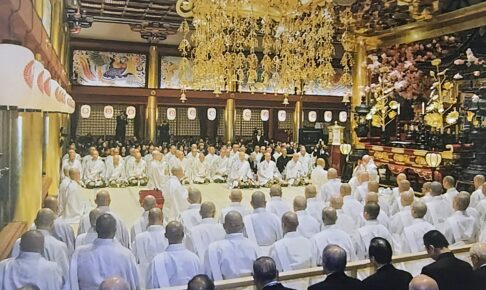
Nichiren Daishonin transmitted the Heritage of the Law only to His designated successor, the Second High Priest, Nikko Shonin. Nikko Shonin transferred the Heritage of the Law to the Third High Priest, Nichimoku Shonin, and it has been passed down through the unbroken succession of High Priests at the Head Temple Taisekiji to the current High Priest. Nichiren Shoshu is the only orthodox sect which has handed down the Daishonin’s teaching correctly in such an unbroken line.
Nichiren Daishonin repeatedly maintained that the different sects of Buddhism had gone astray concerning the true object of worship. He taught: We must take faith in the superior teaching as our object of worship.
(Gosho, p. 1275)
The Daishonin established the Gohonzon as the True Object of Worship for the age of Mappo. Other so called “Nichiren Sects” do not understand the essence of the Object of Worship. For example, the Nichiren Shu sect at Mt. Minobu appears completely confused concerning its object of worship, sometimes using statues of Shakyamuni, sometimes using mandalas, or chanting the Daimoku to the goddess Kishimojin or even to foxes. They sell mandalas as souvenirs to visitors.
The situation is similar with Rissho Kosei Kai and Reiyukai. Rissho Kosei Kai has changed its object of worship five or six times. Reiyukai, who until recently had revered the posthumous Buddhist names of their ancestors and a mandala of unknown origin, have changed to worshipping a statue of Shakyamuni. There are also several “Nichiren Sects,” such as Kempon Hokke Shu, who make their own counterfeit copies of Gohozons that the Daishonin inscribed. The Soka Gakkai International is a group that was originally founded as a lay organization of Nichiren Shoshu. Due to the refusal of the leaders to correctly follow the teachings of Nichiren Shoshu, this organization was excommunicated. Presently, the members are issued a counterfeit copy of a Gohonzon inscribed by Nichiren Shoshu Twenty-sixth High Priest, Nichikan Shonin.
Although they may use the words “Nichiren Sect” or “NamMyoho-Renge-Kyo,” their actual teachings are completely different from those of Nichiren Daishonin. Superficially, they appear similar to the Daishonin’s True Buddhism, but in reality they are nothing other than false religions and, as such, deceive many people and lead them along the wrong path.
The only true religion which has any power in this world at this time is Nichiren Shoshu. Its doctrines are perfectly logical and consistent, and the experiences of the many people who have faith in this great Buddhism and who have overcome their negative karma are proof of this.
THE NEGATIVE INFLUENCE OF FALSE RELIGIONS
Some people maintain that other sects are not false because they have had their prayers answered by believing in such-and-such a religion, or that their illness was cured through a particular practice. Such arguments may seem reasonable. No matter how crude a teaching, some benefit may be gained from it. People may think their situation has improved or that they have had their prayers answered, but the Daishonin teaches that this is only temporary, and in the long run they invite great misfortune, because they are going against the True Law. Their subsequent thoughts and activities continue to arise out of a false world view.
Nichiren Daishonin wrote:
Although they may think they have been given a sign for a moment, this will not answer a prayer to know heaven and earth. Although there seems to be a sign that the devils and demons will give them their protection, the master and the believers will certainly enjoy no peace.
(Gosho, p. 1531)
Through practicing inferior teachings people lose the ability to recognize unhappiness because their senses are clouded by delusion. We often look at the world around us and are shocked by the acute suffering caused by unforeseen disasters, illnesses, suicide, and physical handicaps. People think, “It has nothing to do with me. I don’t suffer any negative influence from provisional teachings.” Nevertheless, if you are born into a family which follows a provisional religion, you will be adversely influenced by it. People are often not aware of the power of religion, so they think that calling other religions false is exclusivist and intolerant, but this is not always so.
If we are to eliminate the root of all unhappiness, we should be wary of the negative influence of provisional teachings and adhere strictly to Nichiren Daishonin’s orthodox teachings.